Pearson+ LogoPearson+ Logo
Ch.9 Solutions
McMurry - Fundamentals of GOB 8th Edition
McMurry8th EditionFundamentals of GOBISBN: 9780134015187Not the one you use?Change textbook
Chapter 9, Problem 99b

To prevent accumulation of ice on roads and sidewalks, many municipalities (and home-owners) will apply de-icing compounds to 'melt' the ice by lowering the freezing point.
b. Some de-icing compositions include dyes or colored compounds called indicators. Why?

Verified step by step guidance
1
Understand the purpose of de-icing compounds: De-icing compounds work by lowering the freezing point of water, a process known as freezing point depression. This is a colligative property, meaning it depends on the number of solute particles in the solution rather than their identity.
Recognize the role of indicators: Indicators are dyes or colored compounds added to de-icing compositions to provide visual feedback about the application and effectiveness of the compound.
Explain the practical use of indicators: The color from the indicator helps users see where the de-icing compound has been applied, ensuring even coverage and preventing over-application or missed areas.
Discuss the environmental and safety benefits: Proper application of de-icing compounds reduces waste, minimizes environmental impact, and ensures safer walking or driving conditions by effectively melting ice.
Conclude with the importance of indicators: Indicators are a practical addition to de-icing compounds, improving their usability and effectiveness while promoting safety and environmental responsibility.

Verified video answer for a similar problem:

This video solution was recommended by our tutors as helpful for the problem above.
Video duration:
2m
Was this helpful?

Key Concepts

Here are the essential concepts you must grasp in order to answer the question correctly.

De-icing Compounds

De-icing compounds are substances applied to surfaces like roads and sidewalks to lower the freezing point of water, thereby preventing ice formation. Common examples include salt (sodium chloride) and calcium chloride, which work by disrupting the formation of ice crystals, making it easier to clear surfaces during winter conditions.
Recommended video:
Guided course
02:11
Naming Ionic Compounds

Freezing Point Depression

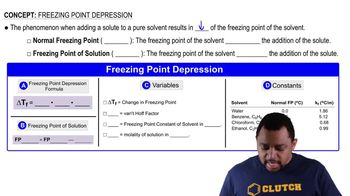
Freezing point depression is a colligative property that describes how the addition of a solute (like salt) to a solvent (like water) lowers the temperature at which the solvent freezes. This principle is crucial for understanding how de-icing agents function, as they allow for the melting of ice at temperatures where pure water would remain frozen.
Recommended video:
Guided course
02:00
Freezing Point Depression Concept 1

Indicators in De-icing Compounds

Indicators are colored compounds added to de-icing agents to provide visual cues about their presence and effectiveness. These dyes help municipalities and homeowners see where the de-icing material has been applied, ensuring even coverage and preventing over-application, which can be harmful to the environment.
Recommended video:
Guided course
02:11
Naming Ionic Compounds
Related Practice
Textbook Question

Hyperbaric chambers, which provide high pressures (up to 6 atm) of either air or pure oxygen, are used to treat a variety of conditions, ranging from decompression sickness in deep-sea divers to carbon monoxide poisoning. Look up the solubility of O2, N2, CO, and CO2 in water at standard temperature and pressure (1 atm, 25 °C).

a. Explain the trends in relative solubility for these gases.

1776
views
Textbook Question

Hyperbaric chambers, which provide high pressures (up to 6 atm) of either air or pure oxygen, are used to treat a variety of conditions, ranging from decompression sickness in deep-sea divers to carbon monoxide poisoning. Look up the solubility of O2, N2, CO, and CO2 in water at standard temperature and pressure (1 atm, 25 °C).

b. Explain how elevated pressures in a hyperbaric chamber be used to treat decompression sickness (excess N2 in blood) and carbon monoxide poisoning.

2430
views
Textbook Question

Look up the composition of Ringer's solution used in the treatment of burns and wounds.

b. What is the osmolarity of the solution? Is it hypertonic, isotonic, or hypotonic with blood plasma (0.30 osmol)? Discuss possible medicinal reasons for the osmolarity of the solution.

1787
views
Textbook Question

Many carbonate minerals are insoluble in water and appear in water pipes as 'scale.'

b. Why is scale formation typically only a problem in hot water pipes?

1284
views
Textbook Question

Research information related to dialysis and answer the following questions:

a. What is the difference between hemodialysis and peritoneal dialysis?

1345
views