
Pearson+ LogoPearson+ Logo
Ch.9 Solutions
McMurry - Fundamentals of GOB 8th Edition
McMurry8th EditionFundamentals of GOBISBN: 9780134015187Not the one you use?Change textbook
Chapter 9, Problem 96b

Hyperbaric chambers, which provide high pressures (up to 6 atm) of either air or pure oxygen, are used to treat a variety of conditions, ranging from decompression sickness in deep-sea divers to carbon monoxide poisoning. Look up the solubility of O2, N2, CO, and CO2 in water at standard temperature and pressure (1 atm, 25 °C).
b. Explain how elevated pressures in a hyperbaric chamber be used to treat decompression sickness (excess N2 in blood) and carbon monoxide poisoning.

Verified step by step guidance
1
Decompression sickness occurs when nitrogen (N₂) gas, which is dissolved in the blood under high pressure (e.g., during a deep-sea dive), forms bubbles as the pressure decreases too quickly. This can cause pain and other serious symptoms.
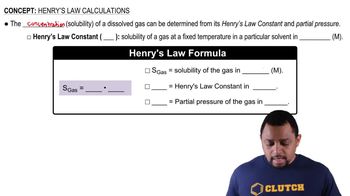
According to Henry's Law, the solubility of a gas in a liquid is directly proportional to the partial pressure of the gas above the liquid. Mathematically, this is expressed as: C=kP, where C is the concentration of the gas, k is the solubility constant, and P is the partial pressure of the gas.
In a hyperbaric chamber, the pressure is increased to several atmospheres, which increases the solubility of nitrogen in the blood. This helps dissolve nitrogen gas bubbles back into the blood, alleviating the symptoms of decompression sickness.
Carbon monoxide (CO) poisoning occurs because CO binds to hemoglobin in red blood cells with a much higher affinity than oxygen (O₂), reducing the blood's ability to carry oxygen to tissues.
In a hyperbaric chamber, the high pressure of pure oxygen increases the partial pressure of O₂ in the blood. This promotes the displacement of CO from hemoglobin and increases the oxygen supply to tissues, helping to treat carbon monoxide poisoning.

Verified video answer for a similar problem:

This video solution was recommended by our tutors as helpful for the problem above.
Video duration:
3m
Was this helpful?

Key Concepts

Here are the essential concepts you must grasp in order to answer the question correctly.

Henry's Law

Henry's Law states that the amount of gas that dissolves in a liquid is directly proportional to the partial pressure of that gas above the liquid. In the context of hyperbaric chambers, increasing the pressure allows more oxygen and nitrogen to dissolve in the blood, which is crucial for treating conditions like decompression sickness and carbon monoxide poisoning.
Recommended video:
Guided course
01:41
Henry's Law Calculations Concept 1

Decompression Sickness

Decompression sickness, also known as 'the bends,' occurs when nitrogen dissolved in the blood forms bubbles as pressure decreases during ascent from deep water. Hyperbaric treatment helps by increasing pressure, allowing excess nitrogen to dissolve back into the blood, thus preventing bubble formation and alleviating symptoms.

Carbon Monoxide Poisoning

Carbon monoxide poisoning occurs when CO binds to hemoglobin in red blood cells more effectively than oxygen, reducing oxygen transport. Hyperbaric oxygen therapy increases the amount of dissolved oxygen in the blood, displacing carbon monoxide from hemoglobin and facilitating its elimination from the body.
Recommended video:
Guided course
5:36
Amino Acid Catabolism: Carbon Atoms Concept 2
Related Practice
Textbook Question

Many compounds are only partially dissociated into ions in aqueous solution. Trichloroacetic acid (CCl3CO2H), for instance, is partially dissociated in water according to the equation

CCl3CO2H(aq) → H+(aq) + CCl3CO2⁻ aq)

For a solution prepared by dissolving 1.00 mol of trichloroacetic acid in 1.00 kg of water, 36.0% of the trichloroacetic acid dissociates to form H+ and CCl3CO2⁻ ions.

a. What is the total concentration of dissolved ions and molecules in 1 kg of water?

1627
views
Textbook Question

Many compounds are only partially dissociated into ions in aqueous solution. Trichloroacetic acid (CCl3CO2H), for instance, is partially dissociated in water according to the equation

CCl3CO2H(aq) → H+(aq) + CCl3CO2⁻ aq)

For a solution prepared by dissolving 1.00 mol of trichloroacetic acid in 1.00 kg of water, 36.0% of the trichloroacetic acid dissociates to form H+ and CCl3CO2⁻ ions.

b. What is the freezing point of this solution? (The freezing point of 1 kg of water is lowered 1.86 °C for each mole of solute particles.)

1415
views
Textbook Question

Hyperbaric chambers, which provide high pressures (up to 6 atm) of either air or pure oxygen, are used to treat a variety of conditions, ranging from decompression sickness in deep-sea divers to carbon monoxide poisoning. Look up the solubility of O2, N2, CO, and CO2 in water at standard temperature and pressure (1 atm, 25 °C).

a. Explain the trends in relative solubility for these gases.

1776
views
Textbook Question

Look up the composition of Ringer's solution used in the treatment of burns and wounds.

b. What is the osmolarity of the solution? Is it hypertonic, isotonic, or hypotonic with blood plasma (0.30 osmol)? Discuss possible medicinal reasons for the osmolarity of the solution.

1786
views
Textbook Question

To prevent accumulation of ice on roads and sidewalks, many municipalities (and home-owners) will apply de-icing compounds to 'melt' the ice by lowering the freezing point.

b. Some de-icing compositions include dyes or colored compounds called indicators. Why?

1253
views
Textbook Question

Many carbonate minerals are insoluble in water and appear in water pipes as 'scale.'

b. Why is scale formation typically only a problem in hot water pipes?

1284
views