Pearson+ LogoPearson+ Logo
Ch.13 Alkenes, Alkynes, and Aromatic Compounds
McMurry - Fundamentals of GOB 8th Edition
McMurry8th EditionFundamentals of GOBISBN: 9780134015187Not the one you use?Change textbook
Chapter 13, Problem 63

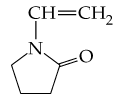
Polyvinylpyrrolidone (PVP) is often used in hair sprays to hold hair in place. Draw a few units of the PVP polymer. The vinylpyrrolidone monomer unit has the following structure:
Chemical structure of the vinylpyrrolidone monomer unit used in polyvinylpyrrolidone (PVP) polymer.

Verified step by step guidance
1
Understand the problem: The task is to draw a few repeating units of the PVP polymer. A polymer is made by linking monomer units together in a repeating pattern. The monomer provided is vinylpyrrolidone, and we need to visualize how these units connect to form the polymer.
Identify the polymerization process: Vinylpyrrolidone undergoes addition polymerization. This means the double bond in the vinyl group (C=C) of the monomer opens up, allowing the monomers to link together in a chain.
Determine the repeating unit: The repeating unit of the polymer is derived from the monomer by breaking the double bond in the vinyl group. The carbon atoms from the double bond will form single bonds with neighboring monomers, creating a continuous chain.
Draw the structure of the repeating unit: Start with the pyrrolidone ring (a five-membered lactam ring) as the central feature. Attach the two carbon atoms from the vinyl group to the ring, ensuring the double bond is replaced with single bonds that connect to adjacent repeating units.
Replicate the repeating unit: To represent the polymer, draw at least three repeating units connected in a chain. Use brackets to indicate that the structure continues indefinitely, and include an 'n' outside the brackets to denote the number of repeating units in the polymer.

Verified video answer for a similar problem:

This video solution was recommended by our tutors as helpful for the problem above.
Was this helpful?

Key Concepts

Here are the essential concepts you must grasp in order to answer the question correctly.

Polyvinylpyrrolidone (PVP)

Polyvinylpyrrolidone (PVP) is a synthetic polymer derived from the monomer vinylpyrrolidone. It is known for its film-forming properties, making it an effective ingredient in hair sprays and other cosmetic products. PVP helps to provide hold and structure to hairstyles by forming a flexible film around the hair strands.

Polymer Structure

Polymers are large molecules composed of repeating structural units called monomers. In the case of PVP, the polymer is formed by the polymerization of vinylpyrrolidone monomers, resulting in a long chain of interconnected units. Understanding the structure of PVP is crucial for grasping how its properties contribute to its function in hair care products.
Recommended video:
Guided course
1:01
Structural Formula Concept 2

Monomer Unit

A monomer is a small, simple molecule that can join together with other monomers to form a polymer. The vinylpyrrolidone monomer unit contains a pyrrolidone ring, which contributes to the solubility and film-forming characteristics of PVP. Recognizing the structure of the monomer is essential for understanding how it transforms into the polymer and its applications in various products.
Recommended video:
Guided course
01:15
Pressure Units Concept 1