Pearson+ LogoPearson+ Logo
Ch.13 Alkenes, Alkynes, and Aromatic Compounds
McMurry - Fundamentals of GOB 8th Edition
McMurry8th EditionFundamentals of GOBISBN: 9780134015187Not the one you use?Change textbook
Chapter 13, Problem 61

2,2,3,3-Tetrabromopentane can be prepared by an addition reaction of excess Br2 with an alkyne. Draw the structure of the alkyne and name it.

Verified step by step guidance
1
Identify the product structure: The given compound, 2,2,3,3-Tetrabromopentane, has four bromine atoms attached to the second and third carbons of a pentane chain. This indicates that the starting alkyne must have a triple bond between the second and third carbons, as bromine adds across the triple bond in an addition reaction.
Determine the alkyne structure: To form 2,2,3,3-Tetrabromopentane, the alkyne must have five carbon atoms in total, with the triple bond located between the second and third carbons. The structure of the alkyne is CH3-C≡C-CH2-CH3.
Name the alkyne: The IUPAC name for the alkyne is 2-pentyne. The numbering starts from the end of the chain closest to the triple bond to give the lowest possible number to the triple bond.
Explain the reaction: When excess Br2 reacts with an alkyne, the bromine molecules add across the triple bond in two steps. First, the triple bond is converted to a double bond with two bromine atoms added. Then, the double bond reacts with more Br2 to form a single bond with four bromine atoms added in total.
Verify the product: After the addition of excess Br2 to 2-pentyne, the final product is 2,2,3,3-Tetrabromopentane, confirming that the starting alkyne is correctly identified as 2-pentyne.

Verified video answer for a similar problem:

This video solution was recommended by our tutors as helpful for the problem above.
Was this helpful?

Key Concepts

Here are the essential concepts you must grasp in order to answer the question correctly.

Alkynes

Alkynes are hydrocarbons that contain at least one carbon-carbon triple bond. They are unsaturated compounds characterized by the general formula CnH2n-2. The presence of the triple bond gives alkynes unique reactivity, making them suitable for various addition reactions, such as halogenation with bromine.
Recommended video:
Guided course
4:11
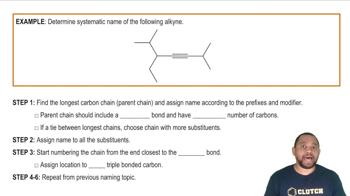
Naming Alkynes Example 1

Addition Reactions

Addition reactions involve the addition of atoms or groups to a molecule, typically across a double or triple bond. In the case of alkynes, the triple bond can react with halogens like Br2, resulting in the formation of a saturated compound. This type of reaction is crucial in organic synthesis for modifying molecular structures.
Recommended video:
Guided course
2:55
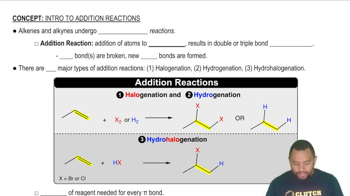
Addition Reactions Concept 1

Bromination

Bromination is a specific type of addition reaction where bromine (Br2) is added to a compound. For alkynes, this process can lead to the formation of dibrominated products, such as 2,2,3,3-tetrabromopentane. Understanding bromination is essential for predicting the products of reactions involving alkynes and for naming the resulting compounds.
Recommended video:
Guided course
0:35
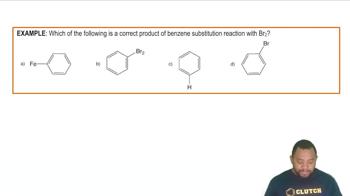
Halogenation Reactions Example 1