Pearson+ LogoPearson+ Logo
Ch.13 Alkenes, Alkynes, and Aromatic Compounds
McMurry - Fundamentals of GOB 8th Edition
McMurry8th EditionFundamentals of GOBISBN: 9780134015187Not the one you use?Change textbook
Chapter 13, Problem 62

1-Pentyne reacts with HBr in a 1:1 molar ratio to yield two different addition products, both being bromopentenes and having the chemical formula C5H9Br. Draw the structures of two possible products.

Verified step by step guidance
1
Identify the structure of 1-pentyne, which is a terminal alkyne with the molecular formula C₅H₈. Its structure consists of a triple bond between the first and second carbon atoms in a five-carbon chain.
Understand the reaction mechanism: The addition of HBr to an alkyne follows Markovnikov's rule, where the hydrogen atom adds to the carbon with more hydrogens, and the bromine atom adds to the carbon with fewer hydrogens. However, in this case, the reaction can proceed in two steps, leading to two different products.
For the first product, consider the addition of HBr to the triple bond to form a double bond. The hydrogen atom adds to the terminal carbon (C1), and the bromine atom adds to the adjacent carbon (C2), resulting in 2-bromo-1-pentene.
For the second product, consider the possibility of anti-Markovnikov addition due to the presence of radicals or other reaction conditions. In this case, the hydrogen atom adds to the C2 carbon, and the bromine atom adds to the terminal carbon (C1), resulting in 1-bromo-2-pentene.
Draw the structures of the two products: (1) 2-bromo-1-pentene, where the bromine is attached to the second carbon and the double bond is between C1 and C2, and (2) 1-bromo-2-pentene, where the bromine is attached to the first carbon and the double bond is between C2 and C3.

Verified video answer for a similar problem:

This video solution was recommended by our tutors as helpful for the problem above.
Was this helpful?

Key Concepts

Here are the essential concepts you must grasp in order to answer the question correctly.

Alkyne Reactivity

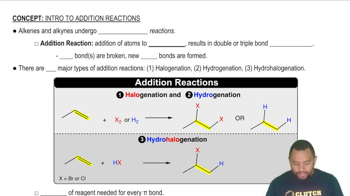
Alkynes, such as 1-pentyne, are hydrocarbons with at least one carbon-carbon triple bond. They undergo electrophilic addition reactions, where reagents like HBr add across the triple bond. This reactivity is crucial for understanding how 1-pentyne can form different products when reacting with HBr.
Recommended video:
Guided course
4:11
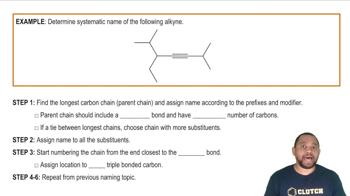
Naming Alkynes Example 1

Markovnikov's Rule

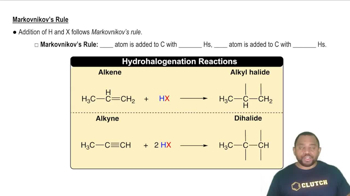
Markovnikov's Rule states that in the addition of HX to an alkene or alkyne, the hydrogen atom will attach to the carbon with the greater number of hydrogen atoms already attached. This principle helps predict the major product in reactions involving unsymmetrical alkenes or alkynes, leading to the formation of different bromopentenes in this case.
Recommended video:
Guided course
1:37
Markovnikov's Rule Concept 2

Stereochemistry of Addition Reactions

Stereochemistry refers to the spatial arrangement of atoms in molecules. In the case of 1-pentyne reacting with HBr, the addition can lead to different stereoisomers, depending on the orientation of the bromine and hydrogen atoms. Understanding stereochemistry is essential for accurately drawing the structures of the resulting bromopentenes.
Recommended video:
Guided course
2:55
Addition Reactions Concept 1