Pearson+ LogoPearson+ Logo
Ch.13 Alkenes, Alkynes, and Aromatic Compounds
McMurry - Fundamentals of GOB 8th Edition
McMurry8th EditionFundamentals of GOBISBN: 9780134015187Not the one you use?Change textbook
Chapter 13, Problem 68

The explosive trinitrotoluene (TNT) is made by carrying out three successive nitration reactions on toluene. If these nitrations only occur in the ortho and para positions relative to the methyl group, what is the structure of TNT?

Verified step by step guidance
1
Understand the starting material: Toluene is a benzene ring with a single methyl group (-CH₃) attached to it. This methyl group is an electron-donating group, which directs incoming substituents to the ortho (adjacent) and para (opposite) positions on the benzene ring during electrophilic substitution reactions.
Recognize the reaction type: Nitration involves the substitution of a hydrogen atom on the benzene ring with a nitro group (-NO₂). This is achieved using a mixture of concentrated nitric acid (HNO₃) and sulfuric acid (H₂SO₄), which generates the nitronium ion (NO₂⁺), the electrophile in this reaction.
First nitration: The first nitro group substitutes at the para position relative to the methyl group because the para position is more accessible and stable due to steric and electronic effects.
Second nitration: The second nitro group substitutes at one of the ortho positions relative to the methyl group. This occurs because the methyl group continues to direct substituents to the ortho and para positions, and the para position is already occupied.
Third nitration: The third nitro group substitutes at the remaining ortho position relative to the methyl group, completing the trinitration process. The final structure of TNT (trinitrotoluene) is a benzene ring with a methyl group and three nitro groups at the 2, 4, and 6 positions (relative to the methyl group).

Verified video answer for a similar problem:

This video solution was recommended by our tutors as helpful for the problem above.
Was this helpful?

Key Concepts

Here are the essential concepts you must grasp in order to answer the question correctly.

Nitration Reaction

Nitration is a chemical process that introduces a nitro group (-NO2) into an organic compound. In the case of toluene, nitration occurs through electrophilic aromatic substitution, where the aromatic ring reacts with a nitrating agent, typically a mixture of concentrated nitric and sulfuric acids. This reaction can occur at different positions on the aromatic ring, leading to various isomers depending on the substituents present.
Recommended video:
Guided course
1:05
Acid-Base Reaction Example 1

Ortho and Para Positions

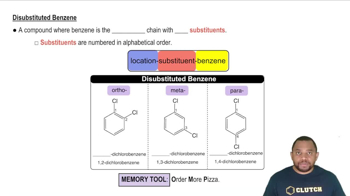
In aromatic compounds, substituents can occupy different positions relative to each other. The ortho position refers to the adjacent carbon atoms on the benzene ring, while the para position refers to the carbon atoms directly opposite each other. For toluene, the methyl group influences the reactivity of the ring, making the ortho and para positions more favorable for further nitration, which is crucial for understanding the final structure of TNT.
Recommended video:
Guided course
2:16
Disubstituted Benzene Concept 2

Structure of TNT

Trinitrotoluene (TNT) is a compound formed by the nitration of toluene, resulting in three nitro groups attached to the aromatic ring. The final structure of TNT includes one methyl group and three nitro groups located at the ortho and para positions relative to the methyl group. This specific arrangement of substituents is responsible for TNT's explosive properties and stability, making it a widely used explosive in military and industrial applications.
Recommended video:
Guided course
1:01
Structural Formula Concept 2