Pearson+ LogoPearson+ Logo
Ch.15 Aldehydes and Ketones
McMurry - Fundamentals of GOB 8th Edition
McMurry8th EditionFundamentals of GOBISBN: 9780134015187Not the one you use?Change textbook
Chapter 15, Problem 3

Draw structures corresponding to the following names:
a. Octanal
b. Methyl phenyl ketone
c. 4-Methylhexanal
d. Methyl tert-butyl ketone

Verified step by step guidance
1
Step 1: Understand the problem. The task is to draw the structures of the given organic compounds based on their names. Each name provides information about the functional groups and the arrangement of carbon atoms in the molecule.
Step 2: For 'Octanal': Identify the root name 'oct-' which indicates an 8-carbon chain. The suffix '-al' indicates the presence of an aldehyde group (-CHO) at the end of the chain. Draw a straight chain of 8 carbons with a terminal aldehyde group.
Step 3: For 'Methyl phenyl ketone': The name indicates a ketone group (C=O) with a methyl group (CH₃) on one side and a phenyl group (C₆H₅) on the other. Draw a structure with a central carbonyl group (C=O) bonded to a methyl group and a phenyl group.
Step 4: For '4-Methylhexanal': The root name 'hex-' indicates a 6-carbon chain. The suffix '-al' indicates an aldehyde group (-CHO) at the end of the chain. The prefix '4-methyl' indicates a methyl group attached to the 4th carbon of the chain. Draw a 6-carbon chain with a terminal aldehyde group and a methyl group on the 4th carbon.
Step 5: For 'Methyl tert-butyl ketone': The name indicates a ketone group (C=O) with a methyl group (CH₃) on one side and a tert-butyl group (C(CH₃)₃) on the other. Draw a structure with a central carbonyl group (C=O) bonded to a methyl group and a tert-butyl group.

Verified video answer for a similar problem:

This video solution was recommended by our tutors as helpful for the problem above.
Was this helpful?

Key Concepts

Here are the essential concepts you must grasp in order to answer the question correctly.

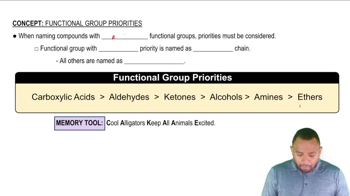
Functional Groups

Functional groups are specific groups of atoms within molecules that are responsible for the characteristic chemical reactions of those molecules. In organic chemistry, recognizing functional groups such as aldehydes, ketones, and alcohols is crucial for understanding the properties and reactivity of compounds. For example, octanal contains an aldehyde functional group, while methyl phenyl ketone contains a ketone functional group.
Recommended video:
Guided course
1:11
Functional Group Priorities Concept 1

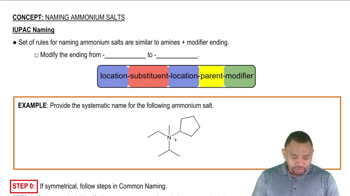
IUPAC Nomenclature

IUPAC nomenclature is a systematic method of naming organic chemical compounds. It provides a standardized way to convey the structure of a compound through its name, which includes information about the length of the carbon chain, the presence of functional groups, and their positions. Understanding IUPAC rules is essential for accurately interpreting and drawing the structures of compounds like 4-methylhexanal and methyl tert-butyl ketone.
Recommended video:
Guided course
3:18
IUPAC Naming Concept 3

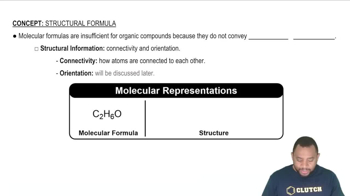
Structural Representation

Structural representation refers to the way in which the molecular structure of a compound is depicted, showing the arrangement of atoms and the bonds between them. This can be done through various methods, including Lewis structures, condensed formulas, or skeletal formulas. Being able to translate names like octanal and methyl phenyl ketone into their corresponding structural representations is key to visualizing and understanding their chemical behavior.
Recommended video:
Guided course
2:08
Molecular Representations Concept 1