Pearson+ LogoPearson+ Logo
Ch.15 Aldehydes and Ketones
McMurry - Fundamentals of GOB 8th Edition
McMurry8th EditionFundamentals of GOBISBN: 9780134015187Not the one you use?Change textbook
Chapter 15, Problem 64

In Problem 15.24, you were given the structure of the free aldehyde form of glucose. Try to draw the two cyclic hemiacetal forms of glucose you would get if (a) the OH on C4 formed the ring and (b) the OH on C3 formed the ring.

Verified step by step guidance
1
Understand the problem: Glucose can form cyclic hemiacetal structures when the aldehyde group on C1 reacts with a hydroxyl group on another carbon atom. In this case, we are tasked with forming two cyclic structures: one where the OH on C4 forms the ring and another where the OH on C3 forms the ring.
Step 1: Recall the structure of glucose in its open-chain form. Glucose is an aldohexose, meaning it has an aldehyde group (-CHO) on C1 and hydroxyl groups (-OH) on carbons C2 through C6.
Step 2: For part (a), identify the OH group on C4. To form a cyclic hemiacetal, the oxygen atom of the OH group on C4 will attack the carbonyl carbon (C1). This reaction forms a six-membered ring (a pyranose structure). Draw the resulting structure, ensuring that the new bond between C1 and the oxygen of C4 is shown, and adjust the stereochemistry of the substituents accordingly.
Step 3: For part (b), identify the OH group on C3. In this case, the oxygen atom of the OH group on C3 will attack the carbonyl carbon (C1). This reaction forms a five-membered ring (a furanose structure). Draw the resulting structure, showing the new bond between C1 and the oxygen of C3, and adjust the stereochemistry of the substituents as needed.
Step 4: Label the anomeric carbon (C1) in both structures. The anomeric carbon is the carbon that was originally part of the carbonyl group. Depending on the orientation of the substituents around the anomeric carbon, you may have two possible anomers (α and β) for each cyclic form. Indicate these possibilities in your drawings.

Verified video answer for a similar problem:

This video solution was recommended by our tutors as helpful for the problem above.
Was this helpful?

Key Concepts

Here are the essential concepts you must grasp in order to answer the question correctly.

Aldehyde Structure of Glucose

Glucose is a simple sugar that can exist in an open-chain form as an aldehyde. In this form, it has a carbonyl group (C=O) at the first carbon atom, which is crucial for understanding its reactivity and ability to form cyclic structures. The aldehyde group plays a significant role in the formation of hemiacetals when glucose reacts with its hydroxyl groups.
Recommended video:
Guided course
0:34
Naming Aldehydes Example 2

Cyclic Hemiacetal Formation

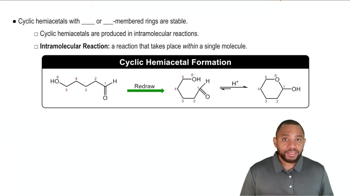
Cyclic hemiacetals are formed when a hydroxyl group reacts with the carbonyl group of an aldehyde, resulting in a ring structure. In glucose, this process can occur at different carbon atoms, leading to different cyclic forms. The position of the hydroxyl group that reacts determines whether the ring closes at C3 or C4, resulting in distinct anomeric forms of glucose.
Recommended video:
Guided course
2:55
Cyclic Hemiacetals Concept 2

Anomeric Carbon

The anomeric carbon is the carbon atom in a sugar that becomes a new chiral center when the sugar cyclizes. In glucose, the anomeric carbon is C1, which can exist in two configurations (alpha and beta) depending on the orientation of the hydroxyl group attached to it. Understanding the concept of the anomeric carbon is essential for predicting the properties and reactivity of the cyclic forms of glucose.
Recommended video:
Guided course
5:36
Amino Acid Catabolism: Carbon Atoms Concept 2