
Pearson+ LogoPearson+ Logo
Ch.16 Amines
McMurry - Fundamentals of GOB 8th Edition
McMurry8th EditionFundamentals of GOBISBN: 9780134015187Not the one you use?Change textbook
Chapter 16, Problem 61

Lemon juice, which contains citric acid, is traditionally recommended for removing the odor associated with cleaning fish. What functional group is responsible for a 'fishy' odor, and why does lemon juice work to remove the odor? If possible, test this at home using a piece of fish.

Verified step by step guidance
1
Identify the functional group responsible for the 'fishy' odor. The 'fishy' odor is typically caused by amines, which are organic compounds containing the functional group \( \text{R-NH}_2 \) (primary amines), \( \text{R}_2\text{NH} \) (secondary amines), or \( \text{R}_3\text{N} \) (tertiary amines). These compounds are basic and volatile, contributing to the strong odor.
Understand the chemical properties of citric acid in lemon juice. Citric acid is a weak organic acid with the formula \( \text{C}_6\text{H}_8\text{O}_7 \). It contains carboxylic acid groups \( \text{-COOH} \), which can donate protons (\( \text{H}^+ \)) in an acid-base reaction.
Explain the reaction between amines and citric acid. When amines (basic) come into contact with citric acid (acidic), an acid-base reaction occurs. The amines accept protons from the citric acid, forming ammonium ions \( \text{R-NH}_3^+ \), which are non-volatile and odorless.
Describe why this reaction removes the odor. The conversion of volatile amines to non-volatile ammonium ions eliminates the 'fishy' smell because the ammonium ions do not evaporate into the air as easily as the amines do.
Optional experiment: To test this at home, rub a piece of fish with lemon juice and observe the reduction in odor. This demonstrates the acid-base reaction between citric acid and the amines present in the fish, neutralizing the odor.

Verified video answer for a similar problem:

This video solution was recommended by our tutors as helpful for the problem above.
Was this helpful?

Key Concepts

Here are the essential concepts you must grasp in order to answer the question correctly.

Functional Groups

Functional groups are specific groups of atoms within molecules that are responsible for the characteristic chemical reactions of those molecules. In the context of odors, certain functional groups, such as amines, are known to produce 'fishy' smells due to their structure and the way they interact with receptors in our noses.
Recommended video:
Guided course
1:11
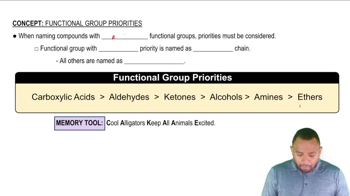
Functional Group Priorities Concept 1

Citric Acid

Citric acid is a weak organic acid found in citrus fruits, including lemons. It has the ability to neutralize basic compounds, such as amines, which are often responsible for unpleasant odors. By reacting with these compounds, citric acid can effectively mask or eliminate the 'fishy' smell associated with fish.
Recommended video:
Guided course
2:31
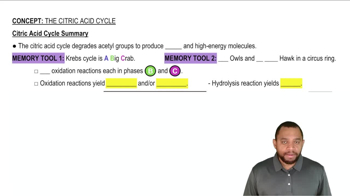
Citric Acid Cycle Summary Concept 12

Odor Neutralization

Odor neutralization refers to the process of eliminating or masking unpleasant smells through chemical reactions or absorption. In the case of lemon juice, the citric acid interacts with the odor-causing compounds, altering their structure and reducing their volatility, which diminishes the perception of the 'fishy' odor.
Recommended video:
Guided course
00:37
Lewis Dot Structures: Neutral Compounds (Simplified) Concept 1