Pearson+ LogoPearson+ Logo
Ch.17 Carboxylic Acids and Their Derivatives
McMurry - Fundamentals of GOB 8th Edition
McMurry8th EditionFundamentals of GOBISBN: 9780134015187Not the one you use?Change textbook
Chapter 17, Problem 38

Write the equation for the ionization of hexanoic acid in water at pH 7.4.

Verified step by step guidance
1
Hexanoic acid (C₆H₁₂O₂) is a weak acid, so it partially ionizes in water. The general reaction for the ionization of a weak acid is: HA + H₂O ⇌ H₃O⁺ + A⁻, where HA is the weak acid and A⁻ is its conjugate base.
In this case, hexanoic acid (C₆H₁₂O₂) acts as HA. When it reacts with water, it donates a proton (H⁺) to water, forming hydronium ion (H₃O⁺) and the conjugate base, hexanoate ion (C₆H₁₁O₂⁻).
The chemical equation for the ionization of hexanoic acid in water is: C₆H₁₂O₂ + H₂O ⇌ H₃O⁺ + C₆H₁₁O₂⁻.
At pH 7.4, the solution is slightly basic, but hexanoic acid will still partially ionize because it is a weak acid. The extent of ionization depends on its acid dissociation constant (Ka).
To fully understand the behavior of hexanoic acid at pH 7.4, you would compare the pH to the pKa of hexanoic acid. If pH > pKa, the conjugate base (C₆H₁₁O₂⁻) will predominate; if pH < pKa, the undissociated acid (C₆H₁₂O₂) will predominate.

Verified video answer for a similar problem:

This video solution was recommended by our tutors as helpful for the problem above.
Was this helpful?

Key Concepts

Here are the essential concepts you must grasp in order to answer the question correctly.

Ionization of Acids

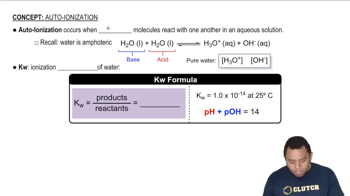
Ionization refers to the process by which an acid donates a proton (H+) to water, resulting in the formation of its conjugate base and hydronium ions (H3O+). For weak acids like hexanoic acid, this process is not complete, and the equilibrium between the undissociated acid and its ions is established.
Recommended video:
Guided course
02:22
Auto-Ionization and Kw

pH and Acid-Base Equilibrium

pH is a measure of the hydrogen ion concentration in a solution, influencing the degree of ionization of weak acids. At a specific pH, such as 7.4, the ratio of ionized to unionized forms of the acid can be determined using the Henderson-Hasselbalch equation, which relates pH to pKa and the concentrations of the acid and its conjugate base.

Hexanoic Acid Structure

Hexanoic acid, a six-carbon fatty acid, has the chemical formula C6H12O2. Its structure includes a carboxylic acid group (-COOH) that is responsible for its acidic properties. Understanding its molecular structure is essential for writing the correct ionization equation and predicting its behavior in aqueous solutions.
Recommended video:
Guided course
0:56
Primary Structure of Nucleic Acids Example 2