Pearson+ LogoPearson+ Logo
Ch.17 Carboxylic Acids and Their Derivatives
McMurry - Fundamentals of GOB 8th Edition
McMurry8th EditionFundamentals of GOBISBN: 9780134015187Not the one you use?Change textbook
Chapter 17, Problem 27

Write the formula for the phosphate monoester formed from isopropyl alcohol and phosphoric acid.

Verified step by step guidance
1
Understand the reaction: This problem involves the formation of a phosphate monoester. A phosphate monoester is formed when one hydroxyl group of phosphoric acid reacts with an alcohol group, resulting in an ester bond. The remaining hydroxyl groups on phosphoric acid remain unreacted.
Identify the reactants: The reactants are isopropyl alcohol (C₃H₈O) and phosphoric acid (H₃PO₄). Isopropyl alcohol contains a hydroxyl (-OH) group, which will react with one of the hydroxyl groups of phosphoric acid.
Write the structural formula for the reactants: Represent isopropyl alcohol as CH₃-CHOH-CH₃ and phosphoric acid as O=P(OH)₃. This will help visualize the reaction and the formation of the ester bond.
Determine the product: During the reaction, one hydroxyl group from phosphoric acid and the hydroxyl group from isopropyl alcohol combine to form water (H₂O). The remaining structure forms the phosphate monoester, which can be written as O=P(OCH(CH₃)₂)(OH)₂.
Verify the formula: Ensure the product has the correct number of atoms and bonds. The phosphate monoester formed should have one ester bond (P-O-C) and two unreacted hydroxyl groups (-OH) attached to the phosphorus atom.

Verified video answer for a similar problem:

This video solution was recommended by our tutors as helpful for the problem above.
Video duration:
3m
Was this helpful?

Key Concepts

Here are the essential concepts you must grasp in order to answer the question correctly.

Phosphate Monoester

A phosphate monoester is a compound formed when a phosphate group reacts with an alcohol, resulting in the substitution of one of the hydroxyl groups of the phosphate with an alkyl group. This reaction typically involves the formation of an ester bond, which is characterized by the linkage of the alcohol's carbon atom to the phosphate's oxygen atom. In biological systems, phosphate monoesters play crucial roles in energy transfer and storage.
Recommended video:
Guided course
01:52
Naming Ionic Compounds

Isopropyl Alcohol

Isopropyl alcohol, also known as isopropanol or 2-propanol, is a common solvent and antiseptic. It is a secondary alcohol with the chemical formula C3H8O, where the hydroxyl (-OH) group is attached to the second carbon of the three-carbon chain. In the context of the reaction with phosphoric acid, isopropyl alcohol acts as the alcohol component that will react with the phosphate group to form the phosphate monoester.
Recommended video:
Guided course
1:10
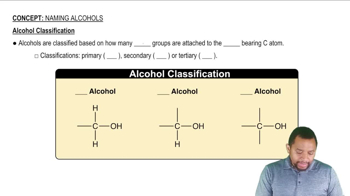
Alcohol Classification Concept 2

Phosphoric Acid

Phosphoric acid is a mineral acid with the chemical formula H3PO4. It is a triprotic acid, meaning it can donate three protons (H+) in solution, leading to the formation of various phosphate species. In the reaction with isopropyl alcohol, phosphoric acid provides the phosphate group that will form the ester bond with the alcohol, resulting in the creation of the phosphate monoester.
Recommended video:
Guided course
02:42
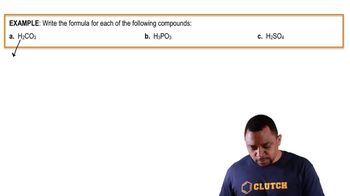
Naming Acids Example 2