Pearson+ LogoPearson+ Logo
Ch.18 Amino Acids and Proteins
McMurry - Fundamentals of GOB 8th Edition
McMurry8th EditionFundamentals of GOBISBN: 9780134015187Not the one you use?Change textbook
Chapter 18, Problem 52

At neutral pH, which of the following amino acids has a net positive charge, which has a net negative charge, and which is neutral? (Hint: Draw the various charged forms of each amino acid before deciding.)
a. Asparagine
b. Lysine
c. Proline

Verified step by step guidance
1
Step 1: Understand the problem. At neutral pH (approximately pH 7), amino acids exist in their zwitterionic form, where the amino group is protonated (NH₃⁺) and the carboxyl group is deprotonated (COO⁻). The net charge of the amino acid depends on the side chain (R group). Analyze the side chains of each amino acid to determine their charge at neutral pH.
Step 2: Analyze asparagine. Asparagine has a side chain with an amide group (-CONH₂), which does not ionize at physiological pH. Therefore, asparagine is neutral at pH 7.
Step 3: Analyze lysine. Lysine has a side chain with an amino group (-NH₂) that can accept a proton to become positively charged (-NH₃⁺) at neutral pH. Therefore, lysine has a net positive charge at pH 7.
Step 4: Analyze proline. Proline has a cyclic structure where the amino group is part of the ring, but its side chain does not ionize at physiological pH. Therefore, proline is neutral at pH 7.
Step 5: Summarize the results. At neutral pH, asparagine is neutral, lysine has a net positive charge, and proline is neutral. Drawing the structures of each amino acid in their zwitterionic forms can help visualize these charges.

Verified video answer for a similar problem:

This video solution was recommended by our tutors as helpful for the problem above.
Was this helpful?

Key Concepts

Here are the essential concepts you must grasp in order to answer the question correctly.

Amino Acid Structure

Amino acids are organic compounds that serve as the building blocks of proteins. Each amino acid has a central carbon atom, an amino group (–NH2), a carboxyl group (–COOH), a hydrogen atom, and a variable side chain (R group). The properties of the side chain determine the amino acid's characteristics, including its charge at different pH levels.
Recommended video:
Guided course
3:03
Amino Acid Catabolism: Amino Group Example 2

Ionization of Amino Acids

At different pH levels, amino acids can gain or lose protons, leading to changes in their charge. At neutral pH (around 7), amino acids exist in a zwitterionic form, where the amino group is protonated (positively charged) and the carboxyl group is deprotonated (negatively charged). This ionization affects the overall net charge of the amino acid.
Recommended video:
Guided course
3:03
Amino Acid Catabolism: Amino Group Example 2

Net Charge of Amino Acids

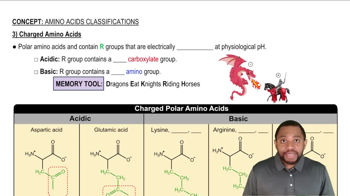
The net charge of an amino acid at a given pH is determined by the balance of its ionized groups. For example, lysine has a positively charged side chain at neutral pH, giving it a net positive charge, while asparagine is neutral, and proline also remains neutral due to its side chain structure. Understanding these charges is crucial for predicting amino acid behavior in biological systems.
Recommended video:
Guided course
4:00
Charged Amino Acids Concept 3