Pearson+ LogoPearson+ Logo
Ch.18 Amino Acids and Proteins
McMurry - Fundamentals of GOB 8th Edition
McMurry8th EditionFundamentals of GOBISBN: 9780134015187Not the one you use?Change textbook
Chapter 18, Problem 48

Draw leucine and identify any chiral carbon atoms with arrows.

Verified step by step guidance
1
Step 1: Begin by understanding the structure of leucine, which is an amino acid. Leucine has the general structure of an amino acid: a central carbon atom (called the alpha carbon) bonded to an amino group (-NH₂), a carboxyl group (-COOH), a hydrogen atom, and a side chain specific to leucine.
Step 2: Draw the structure of leucine. The side chain of leucine is an isobutyl group (-CH₂-CH(CH₃)₂). Attach this side chain to the alpha carbon. The complete structure should show the alpha carbon bonded to the amino group, carboxyl group, hydrogen atom, and the isobutyl side chain.
Step 3: Identify the chiral carbon atoms. A chiral carbon is a carbon atom that is bonded to four different groups. In leucine, the alpha carbon is bonded to four distinct groups: the amino group, the carboxyl group, the hydrogen atom, and the isobutyl side chain. This makes the alpha carbon a chiral center.
Step 4: Use arrows to indicate the chiral carbon atom in your drawing. Clearly mark the alpha carbon with an arrow to show that it is the chiral center in leucine.
Step 5: Verify your drawing and labeling. Ensure that the structure of leucine is correct and that the chiral carbon is properly identified. Double-check that the alpha carbon is bonded to four distinct groups, confirming its chirality.

Verified video answer for a similar problem:

This video solution was recommended by our tutors as helpful for the problem above.
Was this helpful?

Key Concepts

Here are the essential concepts you must grasp in order to answer the question correctly.

Leucine Structure

Leucine is an essential branched-chain amino acid with the chemical formula C6H13NO2. It consists of a central carbon atom (the alpha carbon) bonded to an amino group, a carboxyl group, a hydrogen atom, and a variable side chain (isobutyl group). Understanding its structure is crucial for identifying chiral centers.
Recommended video:
Guided course
1:01
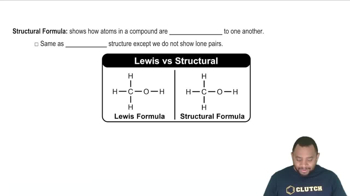
Structural Formula Concept 2

Chirality

Chirality refers to the geometric property of a molecule having non-superimposable mirror images, much like left and right hands. A carbon atom is considered chiral if it is bonded to four different substituents. Identifying chiral centers in leucine is essential for understanding its stereochemistry and biological function.
Recommended video:
Guided course
1:39
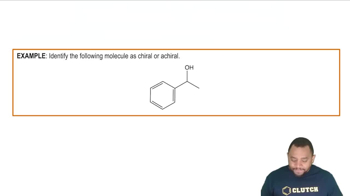
Chirality Example 1

Chiral Carbon Atoms

Chiral carbon atoms are specific carbon atoms in a molecule that have four distinct groups attached to them, leading to two possible stereoisomers. In leucine, the alpha carbon is a chiral center, and recognizing it is important for drawing the molecule accurately and understanding its role in protein structure.
Recommended video:
Guided course
2:37
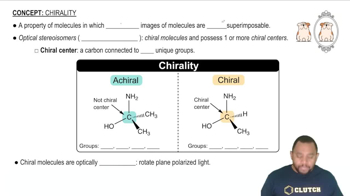
Chirality Concept 1