Pearson+ LogoPearson+ Logo
Ch.18 Amino Acids and Proteins
McMurry - Fundamentals of GOB 8th Edition
McMurry8th EditionFundamentals of GOBISBN: 9780134015187Not the one you use?Change textbook
Chapter 18, Problem 54

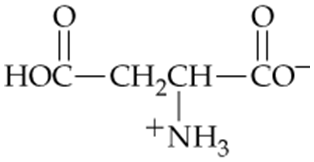
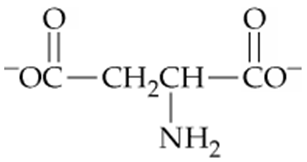
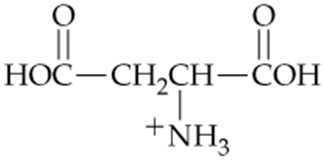
Which of the following forms of aspartic acid would you expect to predominate at low pH, neutral pH, and high pH?
a.
b.
c.

Verified step by step guidance
1
At low pH (acidic conditions), the environment is rich in H⁺ ions. Aspartic acid will predominantly exist in its fully protonated form. This means both the carboxylic acid groups (-COOH) and the amino group (-NH₃⁺) will retain their protons. Identify the structure where all groups are protonated.
At neutral pH (around pH 7), aspartic acid will exist in its zwitterionic form. In this form, the carboxylic acid group on the side chain (-COOH) will lose a proton to become -COO⁻, while the amino group remains protonated as -NH₃⁺. The carboxylic acid group attached to the alpha carbon will also be deprotonated as -COO⁻. Identify the structure that matches this zwitterionic form.
At high pH (basic conditions), the environment has a low concentration of H⁺ ions. Aspartic acid will lose protons from all its acidic groups. Both carboxylic acid groups will be deprotonated as -COO⁻, and the amino group will lose its proton to become -NH₂. Identify the structure where all groups are deprotonated.
Compare the given images (a, b, c) to the descriptions of the forms of aspartic acid at low, neutral, and high pH. Match each image to the corresponding pH condition based on the protonation states of the functional groups.
Verify your matches by ensuring that the protonation states of the functional groups in each structure align with the expected chemical behavior of aspartic acid at the specified pH levels.

Verified video answer for a similar problem:

This video solution was recommended by our tutors as helpful for the problem above.
Was this helpful?

Key Concepts

Here are the essential concepts you must grasp in order to answer the question correctly.

pH and Amino Acid Ionization

The pH of a solution affects the ionization state of amino acids, including aspartic acid. At low pH, amino acids tend to be protonated, leading to a positively charged form. At neutral pH, they exist in a zwitterionic form, where the amino group is protonated and the carboxyl group is deprotonated. At high pH, amino acids can become deprotonated, resulting in a negatively charged form.
Recommended video:
Guided course
1:33
Amino Acid Classifications Example 3

Aspartic Acid Structure

Aspartic acid is a polar, negatively charged amino acid with two carboxyl groups and one amino group. Its structure allows it to participate in various biochemical reactions and interactions. Understanding its structure is crucial for predicting how it behaves under different pH conditions, as the ionization of its functional groups will determine its charge and solubility.
Recommended video:
Guided course
0:56
Primary Structure of Nucleic Acids Example 2

Zwitterionic Form

The zwitterionic form of an amino acid is a dipolar ion that has both a positive and a negative charge, resulting in a net charge of zero. This form is typically predominant at physiological pH (around 7.4) and is important for the solubility and reactivity of amino acids in biological systems. Recognizing the zwitterionic state helps in understanding how aspartic acid interacts in various environments.
Recommended video:
Guided course
02:35
Periodic Table: Elemental Forms (Simplified) Concept 1