Pearson+ LogoPearson+ Logo
Ch.18 Amino Acids and Proteins
McMurry - Fundamentals of GOB 8th Edition
McMurry8th EditionFundamentals of GOBISBN: 9780134015187Not the one you use?Change textbook
Chapter 18, Problem 5a

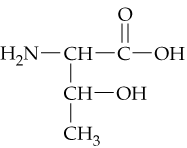
Indicate whether each of the following molecules is an α-amino acid or not, and explain why.  
a. Structural formula of an amino acid showing its α-amino group, carboxyl group, and side chain.

Verified step by step guidance
1
Step 1: Recall the structure of an α-amino acid. An α-amino acid contains a central carbon atom (called the α-carbon) bonded to four groups: an amino group (-NH₂), a carboxyl group (-COOH), a hydrogen atom, and a variable side chain (R group).
Step 2: Examine the structure of the molecule provided in the image. Identify the central carbon atom and check if it is bonded to the four required groups: an amino group, a carboxyl group, a hydrogen atom, and a side chain.
Step 3: Verify the position of the amino group. For the molecule to be an α-amino acid, the amino group must be attached to the α-carbon, which is the same carbon atom bonded to the carboxyl group.
Step 4: If the molecule meets all the criteria (central α-carbon bonded to the amino group, carboxyl group, hydrogen, and side chain), it is an α-amino acid. If any of these criteria are not met, it is not an α-amino acid.
Step 5: Provide a clear explanation based on your analysis of the molecule's structure, specifying whether it is an α-amino acid or not and why.

Verified video answer for a similar problem:

This video solution was recommended by our tutors as helpful for the problem above.
Was this helpful?

Key Concepts

Here are the essential concepts you must grasp in order to answer the question correctly.

α-Amino Acid Structure

An α-amino acid is characterized by having an amino group (-NH2) and a carboxyl group (-COOH) attached to the same carbon atom, known as the α-carbon. This structure is fundamental to the classification of amino acids, as it distinguishes them from other types of amino acids that may not have both functional groups on the same carbon.
Recommended video:
Guided course
3:03
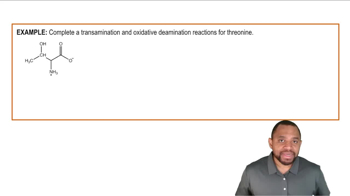
Amino Acid Catabolism: Amino Group Example 2

Classification of Amino Acids

Amino acids can be classified based on their side chains (R groups) into categories such as polar, nonpolar, acidic, and basic. This classification is important for understanding the properties and functions of amino acids in proteins, as the nature of the side chain influences how the amino acid interacts with other molecules.
Recommended video:
Guided course
1:33
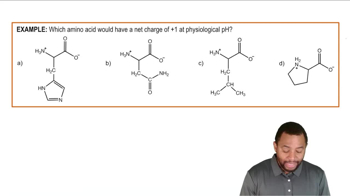
Amino Acid Classifications Example 3

Role in Protein Synthesis

α-Amino acids are the building blocks of proteins, linked together by peptide bonds during protein synthesis. The sequence and composition of these amino acids determine the structure and function of the resulting protein, making it essential to identify whether a molecule is an α-amino acid when studying biological processes.
Recommended video:
Guided course
1:54
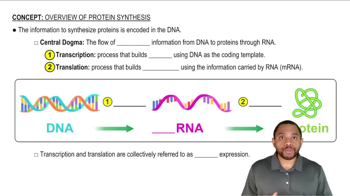
Overview of Protein Synthesis Concept 1