
Pearson+ LogoPearson+ Logo
Ch.18 Amino Acids and Proteins
McMurry - Fundamentals of GOB 8th Edition
McMurry8th EditionFundamentals of GOBISBN: 9780134015187Not the one you use?Change textbook
Chapter 18, Problem 112

List the amino acids with side chains that are capable of hydrogen bonding. Draw an example of two of these amino acids hydrogen bonding to one another. For each one, draw a hydrogen bond to water in a separate sketch. Refer to Section 8.2 for help with drawing hydrogen bonds.

Verified step by step guidance
1
Identify the amino acids with side chains that are capable of hydrogen bonding. These include amino acids with polar side chains containing functional groups such as hydroxyl (-OH), amine (-NH2), or carbonyl (C=O). Examples include serine, threonine, tyrosine, asparagine, and glutamine.
Understand the concept of hydrogen bonding. A hydrogen bond occurs when a hydrogen atom covalently bonded to an electronegative atom (like O or N) interacts with another electronegative atom. This is a key interaction in amino acids with polar side chains.
To draw two amino acids hydrogen bonding to one another, select two amino acids with polar side chains (e.g., serine and asparagine). Represent their structures, ensuring the functional groups capable of hydrogen bonding are shown. Draw a dashed line between the hydrogen donor (e.g., -OH or -NH2) and the acceptor (e.g., O or N) to indicate the hydrogen bond.
For each amino acid, draw a separate sketch showing how it can form a hydrogen bond with water. Represent the water molecule (H2O) and show the interaction between the hydrogen donor or acceptor on the amino acid and the water molecule. Use a dashed line to indicate the hydrogen bond.
Review Section 8.2 for guidance on proper hydrogen bond representation, ensuring the bond angles and distances are depicted accurately. This will help reinforce the correct visualization of hydrogen bonding interactions.

Verified video answer for a similar problem:

This video solution was recommended by our tutors as helpful for the problem above.
Was this helpful?

Key Concepts

Here are the essential concepts you must grasp in order to answer the question correctly.

Amino Acids and Side Chains

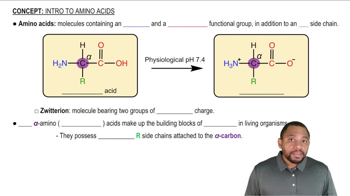
Amino acids are organic compounds that serve as the building blocks of proteins. Each amino acid has a central carbon atom, an amino group, a carboxyl group, a hydrogen atom, and a variable side chain (R group). The properties of the side chains determine the amino acid's characteristics, including its ability to participate in hydrogen bonding, which is crucial for protein structure and function.
Recommended video:
Guided course
3:04
Intro to Amino Acids Concept 1

Hydrogen Bonding

Hydrogen bonding is a type of weak chemical bond that occurs when a hydrogen atom covalently bonded to an electronegative atom, such as oxygen or nitrogen, experiences an attraction to another electronegative atom. In the context of amino acids, side chains containing polar functional groups can form hydrogen bonds with each other and with water, influencing protein folding and stability.
Recommended video:
Guided course
1:22
Hydrogenation Reactions Concept 1

Hydrogen Bonding with Water

Water is a polar molecule, meaning it has a partial positive charge on one side (hydrogens) and a partial negative charge on the other (oxygen). This polarity allows water to form hydrogen bonds with other polar molecules, including certain amino acids. Understanding how amino acids interact with water through hydrogen bonds is essential for grasping their behavior in biological systems and their role in protein solubility and structure.
Recommended video:
Guided course
1:22
Hydrogenation Reactions Concept 1