
Pearson+ LogoPearson+ Logo
Ch.18 Amino Acids and Proteins
McMurry - Fundamentals of GOB 8th Edition
McMurry8th EditionFundamentals of GOBISBN: 9780134015187Not the one you use?Change textbook
Chapter 18, Problem 109

Which would you expect to be more soluble in water, a peptide containing mostly alanine and leucine or a peptide containing mostly lysine and aspartic acid? Explain. (Hint: Consider side-chain interactions with water.)

Verified step by step guidance
1
Step 1: Understand the nature of the side chains of the amino acids involved. Alanine and leucine have nonpolar, hydrophobic side chains, while lysine has a positively charged (basic) side chain and aspartic acid has a negatively charged (acidic) side chain.
Step 2: Recall that water is a polar solvent, meaning it interacts more favorably with polar or charged molecules through hydrogen bonding and dipole-dipole interactions.
Step 3: Analyze the peptide containing alanine and leucine. Since these amino acids have nonpolar side chains, the peptide will have limited interactions with water, making it less soluble.
Step 4: Analyze the peptide containing lysine and aspartic acid. These amino acids have charged side chains, which can form strong electrostatic interactions and hydrogen bonds with water, increasing the peptide's solubility.
Step 5: Conclude that the peptide containing mostly lysine and aspartic acid would be more soluble in water due to the polar and charged nature of their side chains, which interact favorably with water molecules.

Verified video answer for a similar problem:

This video solution was recommended by our tutors as helpful for the problem above.
Was this helpful?

Key Concepts

Here are the essential concepts you must grasp in order to answer the question correctly.

Polarity of Amino Acids

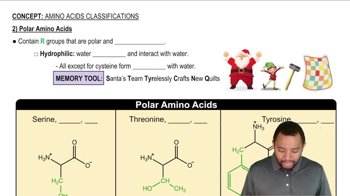
Amino acids have varying side chains that can be polar or nonpolar. Polar amino acids, like lysine and aspartic acid, interact favorably with water due to their ability to form hydrogen bonds. In contrast, nonpolar amino acids, such as alanine and leucine, do not interact well with water, making them less soluble.
Recommended video:
Guided course
2:55
Polar Amino Acids Concept 2

Hydrophilicity vs. Hydrophobicity

Hydrophilicity refers to the affinity of a substance for water, while hydrophobicity indicates a lack of such affinity. Peptides with hydrophilic side chains, like those containing lysine and aspartic acid, tend to dissolve better in water compared to those with hydrophobic side chains, such as alanine and leucine.
Recommended video:
Guided course
3:33
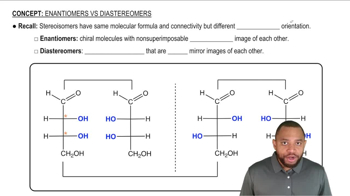
Enantiomers vs Diastereomers Concept 1

Ionic and Hydrogen Bonding

Ionic and hydrogen bonds are crucial for solubility in water. Amino acids like lysine, which has a positively charged side chain, can form ionic bonds with negatively charged water molecules. Similarly, aspartic acid can form hydrogen bonds, enhancing the solubility of peptides rich in these amino acids compared to those with nonpolar residues.
Recommended video:
Guided course
02:33
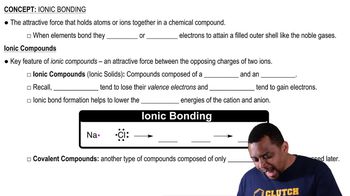
Ionic Bonding Concept 1
Related Practice
Textbook Question

Four of the most abundant amino acids in proteins are leucine, alanine, glycine, and valine. What do these amino acids have in common? Would you expect these amino acids to be found on the interior or on the exterior of the protein?

873
views
Textbook Question

Globular proteins are water-soluble, whereas fibrous proteins are insoluble in water. Indicate whether you expect the following amino acids to be on the surface of a globular protein or on the surface of a fibrous protein.

a. Ala

871
views
Textbook Question

A family visits a pediatrician with their sick child. The four-month-old baby is pale, has obvious episodes of pain, and is not thriving. The doctor orders a series of blood tests, including a test for hemoglobin types. The results show that the infant is not only anemic but that the anemia is due to sickle-cell anemia. The family wants to know if their other two children have sickle-cell anemia, sickle-cell trait, or no sickle-cell gene at all.

a. What test will be used?

730
views
Textbook Question

Which of the following amino acids is most likely to be found on the outside of a soluble protein, and which of them is more likely to be found on the inside? Explain each answer. (Hint: Consider the effect of the amino acid side chain in each case and that the protein is folded up into its globular form.)

a. Valine

841
views
Textbook Question

List the amino acids with side chains that are capable of hydrogen bonding. Draw an example of two of these amino acids hydrogen bonding to one another. For each one, draw a hydrogen bond to water in a separate sketch. Refer to Section 8.2 for help with drawing hydrogen bonds.

743
views