Pearson+ LogoPearson+ Logo
Ch.18 Amino Acids and Proteins
McMurry - Fundamentals of GOB 8th Edition
McMurry8th EditionFundamentals of GOBISBN: 9780134015187Not the one you use?Change textbook
Chapter 18, Problem 12

Two of the 20 common amino acids have two chiral carbon atoms in their structures. Identify these amino acids and their chiral carbon atoms.

Verified step by step guidance
1
Step 1: Recall that a chiral carbon atom is a carbon atom that is bonded to four different groups. This property makes the carbon atom asymmetric, leading to stereoisomerism.
Step 2: Review the structures of the 20 common amino acids. Look for amino acids that have more than one carbon atom meeting the criteria for chirality.
Step 3: Identify threonine and isoleucine as the two amino acids with two chiral carbon atoms. These are the only amino acids among the 20 common ones that meet this condition.
Step 4: For threonine, the first chiral carbon is the alpha carbon (the carbon bonded to the amino group, carboxyl group, and side chain). The second chiral carbon is in the side chain, which is bonded to a hydroxyl group (-OH), a hydrogen atom, and a methyl group (-CH3).
Step 5: For isoleucine, the first chiral carbon is also the alpha carbon. The second chiral carbon is in the side chain, which is bonded to a hydrogen atom, a methyl group (-CH3), and a longer hydrocarbon chain. These two chiral centers make isoleucine unique.

Verified video answer for a similar problem:

This video solution was recommended by our tutors as helpful for the problem above.
Was this helpful?

Key Concepts

Here are the essential concepts you must grasp in order to answer the question correctly.

Chirality

Chirality refers to the geometric property of a molecule having a non-superimposable mirror image. In the context of amino acids, chirality is significant because it affects the molecule's interactions and functions in biological systems. A chiral carbon atom is one that is attached to four different groups, leading to two possible configurations, known as enantiomers.
Recommended video:
Guided course
1:39
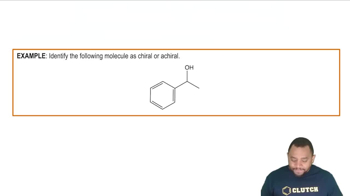
Chirality Example 1

Amino Acids

Amino acids are organic compounds that serve as the building blocks of proteins. There are 20 standard amino acids, each characterized by a central carbon atom, an amino group, a carboxyl group, a hydrogen atom, and a variable side chain (R group). The specific properties and functions of proteins are determined by the sequence and composition of these amino acids.
Recommended video:
Guided course
3:03
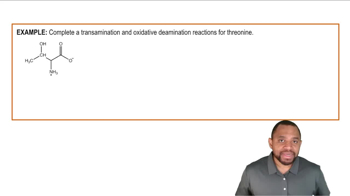
Amino Acid Catabolism: Amino Group Example 2

Chiral Carbon Atoms in Amino Acids

In amino acids, chiral carbon atoms contribute to the molecule's stereochemistry, which is crucial for protein structure and function. The two amino acids with two chiral centers are isoleucine and threonine. Each of these amino acids has two chiral carbons, which allows for multiple stereoisomers, impacting how they interact in biological processes.
Recommended video:
Guided course
2:41
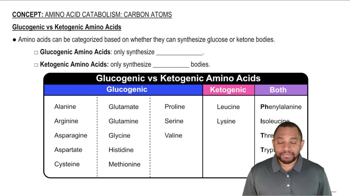
Amino Acid Catabolism: Carbon Atoms Concept 1