Pearson+ LogoPearson+ Logo
Ch.18 Amino Acids and Proteins
McMurry - Fundamentals of GOB 8th Edition
McMurry8th EditionFundamentals of GOBISBN: 9780134015187Not the one you use?Change textbook
Chapter 18, Problem 13

Draw the structure of glutamic acid at low pH, at high pH, and at the two forms that exist between low pH and high pH. Which of these structures represents the zwitterion?

Verified step by step guidance
1
Understand the structure of glutamic acid: Glutamic acid is an amino acid with the formula C₅H₉NO₄. It contains an amino group (-NH₂), a carboxylic acid group (-COOH), and a side chain with another carboxylic acid group (-CH₂-COOH).
At low pH (acidic conditions): All acidic and basic groups are protonated. The amino group (-NH₂) becomes -NH₃⁺, and both carboxylic acid groups (-COOH) remain in their protonated form. Draw the structure with these groups in their protonated states.
At high pH (basic conditions): All acidic and basic groups are deprotonated. The amino group (-NH₃⁺) loses a proton to become -NH₂, and both carboxylic acid groups (-COOH) lose protons to become -COO⁻. Draw the structure with these groups in their deprotonated states.
Between low and high pH (intermediate pH): Glutamic acid exists in two forms. The first form is the zwitterion, where the amino group is protonated (-NH₃⁺) and one carboxylic acid group is deprotonated (-COO⁻), while the other carboxylic acid group remains protonated (-COOH). The second form occurs when both carboxylic acid groups are deprotonated (-COO⁻), and the amino group remains protonated (-NH₃⁺). Draw both structures.
Identify the zwitterion: The zwitterion is the form of glutamic acid where the molecule has both a positive charge (on the -NH₃⁺ group) and a negative charge (on one -COO⁻ group), but the overall charge is neutral. Confirm this by examining the structure drawn in the previous step.

Verified video answer for a similar problem:

This video solution was recommended by our tutors as helpful for the problem above.
Was this helpful?

Key Concepts

Here are the essential concepts you must grasp in order to answer the question correctly.

Amino Acid Structure

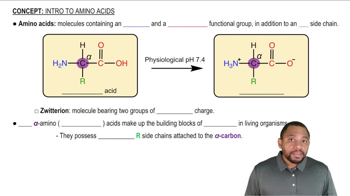
Amino acids, the building blocks of proteins, have a central carbon atom bonded to an amino group, a carboxyl group, a hydrogen atom, and a variable R group. The structure of an amino acid can change based on the pH of the environment, affecting the ionization of the amino and carboxyl groups.
Recommended video:
Guided course
3:03
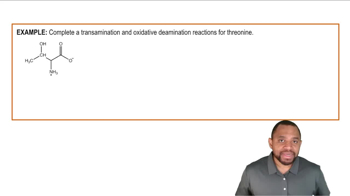
Amino Acid Catabolism: Amino Group Example 2

Zwitterion

A zwitterion is a molecule that has both positive and negative charges but is overall electrically neutral. In the case of amino acids like glutamic acid, at a specific pH (usually around the isoelectric point), the amino group is protonated (positively charged) while the carboxyl group is deprotonated (negatively charged), resulting in a zwitterionic form.
Recommended video:
Guided course
3:04
Intro to Amino Acids Concept 1

pH and Ionization

pH is a measure of the acidity or basicity of a solution, influencing the ionization state of functional groups in amino acids. At low pH, amino acids tend to be fully protonated, while at high pH, they are mostly deprotonated. Understanding how pH affects the ionization of glutamic acid is crucial for drawing its structures at different pH levels.
Recommended video:
Guided course
02:22
Auto-Ionization and Kw