
Textbook Question
What is meant by the following terms as they apply to protein structure, and what bonds or molecular interactions stabilize that level of structure?
b. Secondary structure
619
views

 Verified step by step guidance
 1:11
1:11
 1:24
1:24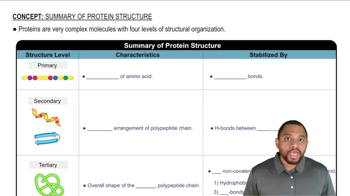 2:56
2:56What is meant by the following terms as they apply to protein structure, and what bonds or molecular interactions stabilize that level of structure?
b. Secondary structure
What is meant by the following terms as they apply to protein structure, and what bonds or molecular interactions stabilize that level of structure?
a. Primary structure
How do the following interactions help to stabilize the tertiary and quaternary structure of a protein? Give an example of a pair of amino acids that could give rise to each interaction.
b. Disulfide bonds
How do the following noncovalent interactions help to stabilize the tertiary and quaternary structure of a protein? Give an example of a pair of amino acids that could give rise to each interaction.
a. Hydrophobic interactions
What is meant by the following terms as they apply to protein structure, and what bonds or molecular interactions stabilize that level of structure?
d. Quaternary structure
What level of protein structure is determined by the following:
b. Hydrogen bonds between backbone carbonyl oxygen atoms and hydrogen atoms attached to backbone nitrogen atoms?