Pearson+ LogoPearson+ Logo
Ch.18 Amino Acids and Proteins
McMurry - Fundamentals of GOB 8th Edition
McMurry8th EditionFundamentals of GOBISBN: 9780134015187Not the one you use?Change textbook
Chapter 18, Problem 84a

What is meant by the following terms as they apply to protein structure, and what bonds or molecular interactions stabilize that level of structure?
a. Primary structure

Verified step by step guidance
1
The primary structure of a protein refers to the linear sequence of amino acids in the polypeptide chain. This sequence is determined by the genetic code in DNA and is unique to each protein.
The amino acids in the primary structure are connected by covalent bonds known as peptide bonds. These bonds form between the carboxyl group (-COOH) of one amino acid and the amino group (-NH2) of the next amino acid through a condensation reaction (loss of water).
The sequence of amino acids in the primary structure determines the protein's overall shape and function, as it influences how the protein will fold into its higher levels of structure.
To represent the primary structure, the amino acids are often written in a single-letter or three-letter code, starting from the N-terminus (amino end) to the C-terminus (carboxyl end).
The stability of the primary structure is solely dependent on the strength of the peptide bonds, which are strong covalent bonds and not easily broken under normal physiological conditions.

Verified video answer for a similar problem:

This video solution was recommended by our tutors as helpful for the problem above.
Was this helpful?

Key Concepts

Here are the essential concepts you must grasp in order to answer the question correctly.

Primary Structure

Primary structure refers to the linear sequence of amino acids in a protein, which is determined by the genetic code. This sequence dictates the protein's unique characteristics and functions. The primary structure is crucial because it serves as the foundation for higher levels of protein folding and stability.
Recommended video:
Guided course
1:11
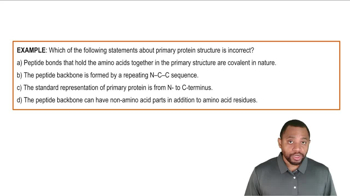
Primary Protein Structure Example 1

Peptide Bonds

Peptide bonds are covalent bonds that link amino acids together in a protein's primary structure. Formed through a dehydration reaction between the amino group of one amino acid and the carboxyl group of another, these bonds are strong and provide the backbone of the protein chain, ensuring its integrity and stability.
Recommended video:
Guided course
1:24
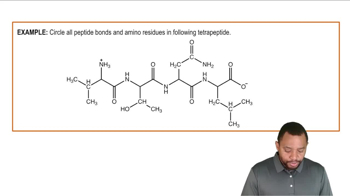
Peptides Example 1

Molecular Interactions

Molecular interactions, such as hydrogen bonds, ionic interactions, and van der Waals forces, play a role in stabilizing the primary structure indirectly by influencing how proteins fold into their secondary and tertiary structures. While these interactions are more prominent in higher-order structures, they can also affect the overall stability of the primary sequence by impacting the protein's environment.
Recommended video:
Guided course
02:08
Molecular Formula