
Pearson+ LogoPearson+ Logo
Ch.19 Enzymes and Vitamins
McMurry - Fundamentals of GOB 8th Edition
McMurry8th EditionFundamentals of GOBISBN: 9780134015187Not the one you use?Change textbook
Chapter 19, Problem 19

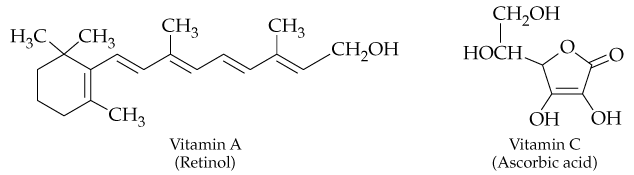
Compare the structures of vitamin A and vitamin C. Which one is water-soluble and which is fat-soluble? What structural features does each have that make one water-soluble and the other fat-soluble?

Verified step by step guidance
1
Examine the structure of Vitamin A (Retinol). It contains a long hydrocarbon chain with multiple double bonds and a hydroxyl (-OH) group at one end. The hydrocarbon chain is nonpolar, making Vitamin A predominantly hydrophobic (fat-soluble).
Examine the structure of Vitamin C (Ascorbic acid). It contains multiple hydroxyl (-OH) groups and a lactone ring. These hydroxyl groups can form hydrogen bonds with water, making Vitamin C hydrophilic (water-soluble).
Identify the key structural feature that makes Vitamin A fat-soluble: the long nonpolar hydrocarbon chain dominates its solubility properties, allowing it to dissolve in fats and oils.
Identify the key structural feature that makes Vitamin C water-soluble: the presence of multiple polar hydroxyl (-OH) groups enables it to interact with water molecules through hydrogen bonding.
Conclude that Vitamin A is fat-soluble due to its hydrophobic hydrocarbon chain, while Vitamin C is water-soluble due to its hydrophilic hydroxyl groups and polar structure.

Verified video answer for a similar problem:

This video solution was recommended by our tutors as helpful for the problem above.
Video duration:
2m
Was this helpful?

Key Concepts

Here are the essential concepts you must grasp in order to answer the question correctly.

Water-Solubility vs. Fat-Solubility

Water-soluble vitamins, like vitamin C, dissolve in water and are easily absorbed into the bloodstream. They are typically excreted through urine, which means they need to be consumed regularly. In contrast, fat-soluble vitamins, such as vitamin A, dissolve in fats and oils, allowing them to be stored in the body's fatty tissues and liver, making them less frequently required in the diet.
Recommended video:
Guided course
02:07
Solubility Rules

Chemical Structure of Vitamin A

Vitamin A (retinol) has a long hydrocarbon chain with a cyclic structure, which contributes to its fat-solubility. The presence of non-polar carbon chains allows it to dissolve in lipids, making it suitable for storage in fatty tissues. Its structure includes a hydroxyl group (-OH) that provides some polar characteristics, but overall, it remains predominantly hydrophobic.
Recommended video:
Guided course
00:58
Chemical Reaction: Chemical Change Concept 1

Chemical Structure of Vitamin C

Vitamin C (ascorbic acid) features multiple hydroxyl groups (-OH) and a lactone ring, which enhance its polarity and solubility in water. These polar functional groups allow vitamin C to interact favorably with water molecules, making it easily soluble and readily absorbed in the body. This structural characteristic is key to its classification as a water-soluble vitamin.
Recommended video:
Guided course
00:49
Chemical Reaction: Chemical Change Example 1