Pearson+ LogoPearson+ Logo
Ch.19 Enzymes and Vitamins
McMurry - Fundamentals of GOB 8th Edition
McMurry8th EditionFundamentals of GOBISBN: 9780134015187Not the one you use?Change textbook
Chapter 19, Problem 20

Based on the structure shown for retinol (vitamin A) and the names of the two related forms of vitamin A, retinal and retinoic acid, what do you expect to be the structural differences among these three compounds?

Verified step by step guidance
1
Examine the structure of retinol (vitamin A). Retinol is an alcohol, meaning it contains a hydroxyl group (-OH) attached to its carbon chain. This functional group is key to its classification as an alcohol.
Understand the structure of retinal. Retinal is an aldehyde, which means it contains a carbonyl group (C=O) at the end of its carbon chain. The structural difference between retinol and retinal is that the hydroxyl group (-OH) in retinol is oxidized to form the aldehyde group (C=O) in retinal.
Consider the structure of retinoic acid. Retinoic acid is a carboxylic acid, which means it contains a carboxyl group (-COOH). The structural difference between retinal and retinoic acid is that the aldehyde group (C=O) in retinal is further oxidized to form the carboxyl group (-COOH) in retinoic acid.
Summarize the progression of functional groups: Retinol (alcohol, -OH) → Retinal (aldehyde, C=O) → Retinoic acid (carboxylic acid, -COOH). These changes occur through oxidation reactions, where the functional group is progressively oxidized.
Relate the structural differences to their chemical properties. The presence of different functional groups (-OH, C=O, -COOH) affects the polarity, reactivity, and biological roles of these compounds, making each form of vitamin A unique in its function.

Verified video answer for a similar problem:

This video solution was recommended by our tutors as helpful for the problem above.
Video duration:
1m
Was this helpful?

Key Concepts

Here are the essential concepts you must grasp in order to answer the question correctly.

Vitamin A Structure

Vitamin A encompasses several compounds, primarily retinol, retinal, and retinoic acid. Retinol is the alcohol form, characterized by a hydroxyl (-OH) group. Retinal, the aldehyde form, has a carbonyl group (C=O) instead of the hydroxyl group, while retinoic acid, the acid form, contains a carboxylic acid group (-COOH). Understanding these structural differences is crucial for grasping their biological functions.
Recommended video:
Guided course
1:01
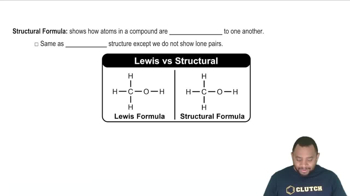
Structural Formula Concept 2

Functional Groups

Functional groups are specific groups of atoms within molecules that determine the chemical reactivity and properties of those molecules. In the case of vitamin A compounds, the presence of different functional groups—hydroxyl in retinol, carbonyl in retinal, and carboxylic acid in retinoic acid—affects their solubility, reactivity, and biological roles, such as vision and gene regulation.
Recommended video:
Guided course
1:11
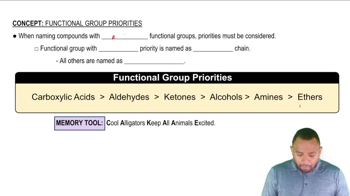
Functional Group Priorities Concept 1

Biological Roles of Vitamin A

Vitamin A plays essential roles in various biological processes, including vision, immune function, and cellular communication. Retinol is crucial for the formation of rhodopsin in the retina, which is vital for low-light vision. Retinal is involved in the visual cycle, while retinoic acid acts as a signaling molecule that regulates gene expression, highlighting the importance of structural variations in their functions.
Recommended video:
Guided course
1:10
Coenzyme A Example 4