Pearson+ LogoPearson+ Logo
Ch.19 Enzymes and Vitamins
McMurry - Fundamentals of GOB 8th Edition
McMurry8th EditionFundamentals of GOBISBN: 9780134015187Not the one you use?Change textbook
Chapter 19, Problem 4b

Describe the reactions that you would expect these enzymes to catalyze.
b. Aspartate transaminase

Verified step by step guidance
1
Understand the role of aspartate transaminase: This enzyme is a type of aminotransferase, which catalyzes the transfer of an amino group from one molecule to another. Specifically, aspartate transaminase facilitates the transfer of an amino group from aspartate to α-ketoglutarate.
Write the general reaction catalyzed by aminotransferases: Aminotransferases typically follow the reaction format: amino acid+α-ketoglutarate  keto acid+glutamate. For aspartate transaminase, the amino acid is aspartate, and the keto acid is oxaloacetate.
Identify the substrates and products: In the reaction catalyzed by aspartate transaminase, the substrates are aspartate and α-ketoglutarate. The products are oxaloacetate (a keto acid) and glutamate (an amino acid).
Describe the mechanism: The reaction involves the enzyme binding to aspartate and transferring its amino group to α-ketoglutarate. This process occurs via a Schiff base intermediate, where the enzyme's cofactor, pyridoxal phosphate (PLP), plays a critical role in facilitating the transfer.
Summarize the biological significance: Aspartate transaminase is crucial in amino acid metabolism and the urea cycle. It helps maintain the balance of amino acids and intermediates in metabolic pathways, such as the citric acid cycle.

Verified video answer for a similar problem:

This video solution was recommended by our tutors as helpful for the problem above.
Video duration:
2m
Was this helpful?

Key Concepts

Here are the essential concepts you must grasp in order to answer the question correctly.

Transamination

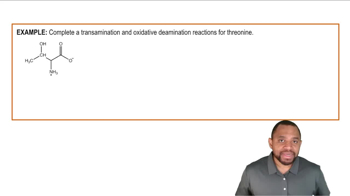
Transamination is a biochemical process that involves the transfer of an amino group from an amino acid to a keto acid. This reaction is crucial for amino acid metabolism and the synthesis of non-essential amino acids. Aspartate transaminase (AST) specifically catalyzes the transfer of an amino group from aspartate to alpha-ketoglutarate, producing oxaloacetate and glutamate.
Recommended video:
Guided course
3:03
Amino Acid Catabolism: Amino Group Example 2

Enzyme Function

Enzymes are biological catalysts that speed up chemical reactions in the body by lowering the activation energy required for the reaction to occur. Each enzyme is specific to a particular substrate and reaction, which means that aspartate transaminase will only catalyze reactions involving aspartate and specific keto acids. Understanding enzyme function is essential for predicting the outcomes of biochemical reactions.
Recommended video:
Guided course
02:16
Logarithmic Functions

Metabolic Pathways

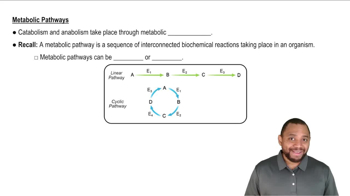
Metabolic pathways are series of interconnected biochemical reactions that occur within a cell, leading to the conversion of substrates into products. Aspartate transaminase plays a key role in the amino acid metabolism pathway, linking amino acid catabolism and the citric acid cycle. Recognizing how these pathways interact helps in understanding the broader implications of enzyme activity in metabolism.
Recommended video:
Guided course
0:52
Metabolic Pathways Concept 2