Pearson+ LogoPearson+ Logo
Ch.19 Enzymes and Vitamins
McMurry - Fundamentals of GOB 8th Edition
McMurry8th EditionFundamentals of GOBISBN: 9780134015187Not the one you use?Change textbook
Chapter 19, Problem 5a

Name the enzyme whose substrate is
a. Urea

Verified step by step guidance
1
Step 1: Understand the problem. The question asks for the name of the enzyme that acts on urea as its substrate. Enzymes are biological catalysts that speed up chemical reactions by binding to specific substrates.
Step 2: Recall the naming convention for enzymes. Enzymes are often named based on the substrate they act upon, followed by the suffix '-ase'.
Step 3: Identify the substrate in this case. The substrate provided in the problem is urea, a compound commonly found in the metabolism of nitrogen-containing compounds.
Step 4: Determine the enzyme that catalyzes the breakdown of urea. The enzyme responsible for this reaction is named based on the substrate (urea) and the suffix '-ase'.
Step 5: Conclude that the enzyme acting on urea is called 'urease'. Urease catalyzes the hydrolysis of urea into ammonia and carbon dioxide.

Verified video answer for a similar problem:

This video solution was recommended by our tutors as helpful for the problem above.
Video duration:
54s
Was this helpful?

Key Concepts

Here are the essential concepts you must grasp in order to answer the question correctly.

Urease

Urease is the enzyme that catalyzes the hydrolysis of urea into ammonia and carbon dioxide. This enzyme is crucial in the nitrogen cycle, as it helps in the breakdown of urea, a waste product from protein metabolism, into less toxic substances. Urease is found in various organisms, including bacteria, plants, and some animals, playing a significant role in soil fertility and the detoxification of urea.

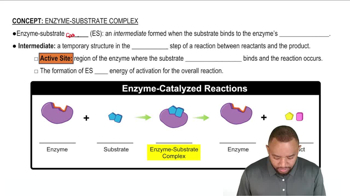
Enzyme-Substrate Specificity

Enzyme-substrate specificity refers to the unique interaction between an enzyme and its specific substrate, which is determined by the enzyme's active site shape and chemical properties. This specificity ensures that enzymes catalyze only particular reactions, leading to efficient metabolic processes. Understanding this concept is essential for identifying which enzyme acts on a given substrate, such as urease acting on urea.
Recommended video:
Guided course
2:32
Enzyme-Substrate Complex Concept 1

Catalysis

Catalysis is the process by which a substance, known as a catalyst, increases the rate of a chemical reaction without being consumed in the process. Enzymes are biological catalysts that facilitate biochemical reactions by lowering the activation energy required for the reaction to occur. This concept is fundamental in biochemistry, as it explains how enzymes like urease accelerate the conversion of urea into ammonia and carbon dioxide.
Recommended video:
Guided course
1:17
Coupled Reactions Example 3