Pearson+ LogoPearson+ Logo
Ch.19 Enzymes and Vitamins
McMurry - Fundamentals of GOB 8th Edition
McMurry8th EditionFundamentals of GOBISBN: 9780134015187Not the one you use?Change textbook
Chapter 19, Problem 3a

The cofactors NAD+, Cu2+, Zn2+, coenzyme A, FAD, and Ni2+ are all needed by your body for enzymatic reactions.
a. Which cofactors are coenzymes?

Verified step by step guidance
1
Understand the difference between cofactors and coenzymes: Cofactors are non-protein chemical compounds or metallic ions required for enzyme activity. Coenzymes are a specific type of cofactor that are organic molecules, often derived from vitamins, and they assist enzymes by transferring chemical groups or electrons.
Review the list of cofactors provided in the problem: NAD+, Cu2+, Zn2+, coenzyme A, FAD, and Ni2+.
Identify which of these are organic molecules (coenzymes) versus metallic ions (inorganic cofactors). Organic molecules typically contain carbon and hydrogen and are often derived from vitamins.
Classify NAD+, coenzyme A, and FAD as coenzymes because they are organic molecules that assist enzymes in transferring electrons or chemical groups during reactions.
Classify Cu2+, Zn2+, and Ni2+ as metallic ion cofactors (not coenzymes) because they are inorganic and do not meet the criteria for coenzymes.

Verified video answer for a similar problem:

This video solution was recommended by our tutors as helpful for the problem above.
Video duration:
3m
Was this helpful?

Key Concepts

Here are the essential concepts you must grasp in order to answer the question correctly.

Cofactors vs. Coenzymes

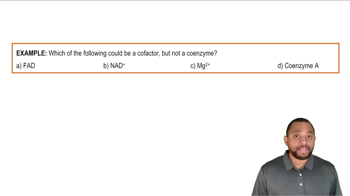
Cofactors are non-protein chemical compounds that assist enzymes in catalyzing reactions. They can be metal ions like Cu<sup>2+</sup> and Zn<sup>2+</sup>, or organic molecules. Coenzymes are a specific type of cofactor that are organic molecules, often derived from vitamins, and are necessary for enzyme function. Understanding the distinction between these terms is crucial for identifying which cofactors in the question are classified as coenzymes.
Recommended video:
Guided course
0:48
Intro to Cofactors Example 1

Role of Coenzymes in Enzymatic Reactions

Coenzymes play a vital role in enzymatic reactions by acting as carriers for chemical groups or electrons. They often participate in the reaction by temporarily binding to the enzyme and substrate, facilitating the conversion of substrates into products. Examples include coenzyme A and FAD, which are involved in various metabolic pathways, highlighting their importance in biochemical processes.
Recommended video:
Guided course
1:10
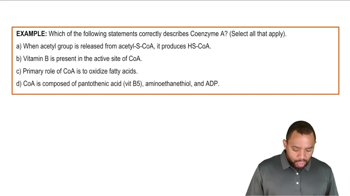
Coenzyme A Example 4

Examples of Coenzymes

Common examples of coenzymes include NAD<sup>+</sup>, FAD, and coenzyme A. NAD<sup>+</sup> is crucial for redox reactions, while FAD is involved in the citric acid cycle and fatty acid oxidation. Coenzyme A is essential for the synthesis and oxidation of fatty acids and the metabolism of carbohydrates. Recognizing these examples helps in understanding which cofactors listed in the question are coenzymes.
Recommended video:
Guided course
1:10
Coenzyme A Example 4