Pearson+ LogoPearson+ Logo
Ch.20 Carbohydrates
McMurry - Fundamentals of GOB 8th Edition
McMurry8th EditionFundamentals of GOBISBN: 9780134015187Not the one you use?Change textbook
Chapter 20, Problem 68

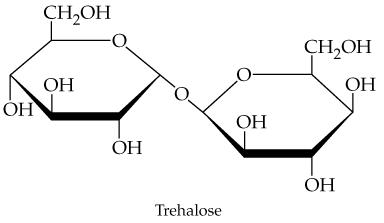
Trehalose, a disaccharide found in the blood of insects, has the following structure. What simple sugars would you obtain on hydrolysis of trehalose? (Hint: Rotate one of the rings in your head or redraw it rotated.)

Verified step by step guidance
1
Understand the problem: Hydrolysis of a disaccharide involves breaking the glycosidic bond between the two monosaccharide units. This process typically yields the two simple sugars that make up the disaccharide.
Examine the structure of trehalose: Trehalose is a disaccharide composed of two glucose molecules linked by an α,α-1,1-glycosidic bond. The hint suggests visualizing one of the rings rotated to better understand the linkage.
Identify the glycosidic bond: In trehalose, the glycosidic bond connects the anomeric carbons (C1) of both glucose units. This is an unusual linkage compared to other disaccharides like maltose or sucrose.
Predict the products of hydrolysis: When trehalose undergoes hydrolysis, the glycosidic bond is cleaved, resulting in two glucose molecules as the products. This reaction is typically catalyzed by an enzyme or acid.
Summarize the result: The simple sugars obtained from the hydrolysis of trehalose are two glucose molecules. This can be confirmed by analyzing the structure and the nature of the glycosidic bond.

Verified video answer for a similar problem:

This video solution was recommended by our tutors as helpful for the problem above.
Video duration:
7m
Was this helpful?

Key Concepts

Here are the essential concepts you must grasp in order to answer the question correctly.

Trehalose Structure

Trehalose is a disaccharide composed of two glucose molecules linked by an α,α-1,1-glycosidic bond. Understanding its structure is crucial for predicting the products of hydrolysis, as the specific linkage determines how the molecule can be broken down into simpler sugars.
Recommended video:
Guided course
1:01
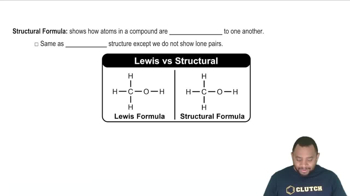
Structural Formula Concept 2

Hydrolysis Reaction

Hydrolysis is a chemical reaction that involves the breaking of a bond in a molecule using water. In the case of trehalose, hydrolysis will cleave the glycosidic bond, resulting in the formation of two monosaccharides, which are the simplest form of carbohydrates.
Recommended video:
Guided course
3:09
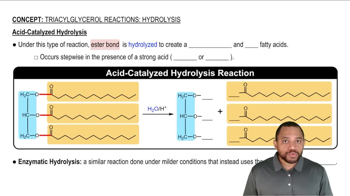
Triacylglycerol Reactions: Hydrolysis Concept 1

Monosaccharides

Monosaccharides are the simplest form of carbohydrates, consisting of single sugar units. In the context of trehalose, hydrolysis yields two glucose molecules, which are key energy sources in biological systems and serve as building blocks for more complex carbohydrates.
Recommended video:
Guided course
0:55
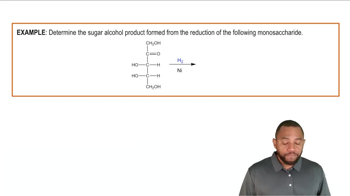
Reduction of Monosaccharides Example 1