Pearson+ LogoPearson+ Logo
Ch.20 Carbohydrates
McMurry - Fundamentals of GOB 8th Edition
McMurry8th EditionFundamentals of GOBISBN: 9780134015187Not the one you use?Change textbook
Chapter 20, Problem 75

Are the α and β forms of the disaccharide lactose enantiomers of each other? Why or why not?

Verified step by step guidance
1
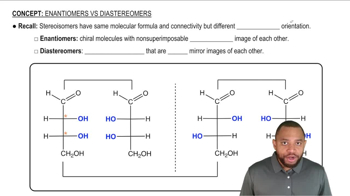
Understand the terms: Enantiomers are stereoisomers that are non-superimposable mirror images of each other. They differ in the arrangement of atoms around a chiral center and have opposite configurations at all chiral centers.
Recall the structure of lactose: Lactose is a disaccharide composed of one molecule of galactose and one molecule of glucose linked by a β-1,4-glycosidic bond. The α and β forms of lactose differ in the configuration of the anomeric carbon of the glucose unit.
Analyze the α and β forms: The α form has the hydroxyl group on the anomeric carbon of the glucose unit pointing down (opposite to the CH₂OH group), while the β form has the hydroxyl group pointing up (same side as the CH₂OH group).
Determine if they are enantiomers: For two molecules to be enantiomers, they must be mirror images of each other and differ at all chiral centers. The α and β forms of lactose differ only at the anomeric carbon of the glucose unit, not at all chiral centers.
Conclude: Since the α and β forms of lactose are not mirror images and differ only at one chiral center, they are not enantiomers. Instead, they are anomers, a specific type of diastereomer that differs at the anomeric carbon.

Verified video answer for a similar problem:

This video solution was recommended by our tutors as helpful for the problem above.
Video duration:
3m
Was this helpful?

Key Concepts

Here are the essential concepts you must grasp in order to answer the question correctly.

Enantiomers

Enantiomers are a type of stereoisomer that are non-superimposable mirror images of each other. They typically arise in molecules that contain one or more chiral centers, where the arrangement of atoms around the chiral center leads to two distinct configurations. Understanding enantiomers is crucial for determining the optical activity and biological interactions of compounds.
Recommended video:
Guided course
3:33
Enantiomers vs Diastereomers Concept 1

Stereoisomerism

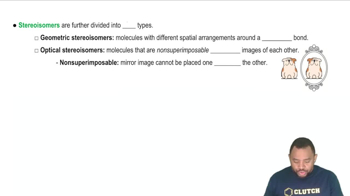
Stereoisomerism refers to the phenomenon where molecules have the same molecular formula and connectivity of atoms but differ in the spatial arrangement of those atoms. This can lead to different physical and chemical properties, including reactivity and interaction with biological systems. Stereoisomers can be further classified into enantiomers and diastereomers.
Recommended video:
Guided course
1:56
Stereoisomers Concept 2

Lactose Structure

Lactose is a disaccharide composed of two monosaccharides: glucose and galactose. The α and ß forms of lactose differ in the configuration around the anomeric carbon of the glucose unit, which affects their properties and interactions. Understanding the structural differences between these forms is essential for determining whether they are enantiomers or not.
Recommended video:
Guided course
1:01
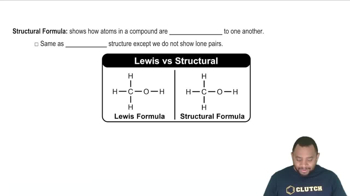
Structural Formula Concept 2