Pearson+ LogoPearson+ Logo
Ch.20 Carbohydrates
McMurry - Fundamentals of GOB 8th Edition
McMurry8th EditionFundamentals of GOBISBN: 9780134015187Not the one you use?Change textbook
Chapter 20, Problem 61

Lactose and maltose are reducing disaccharides, but sucrose is a nonreducing disaccharide. Explain.

Verified step by step guidance
1
Understand the concept of reducing and nonreducing sugars: Reducing sugars have a free anomeric carbon (a carbon attached to the carbonyl group in the sugar) that can participate in redox reactions. Nonreducing sugars lack a free anomeric carbon because it is involved in a glycosidic bond.
Examine the structure of lactose: Lactose is composed of glucose and galactose linked by a β(1→4) glycosidic bond. The glucose unit in lactose has a free anomeric carbon, making it a reducing sugar.
Examine the structure of maltose: Maltose is composed of two glucose units linked by an α(1→4) glycosidic bond. One of the glucose units has a free anomeric carbon, making maltose a reducing sugar.
Examine the structure of sucrose: Sucrose is composed of glucose and fructose linked by an α(1→2) glycosidic bond. In this bond, the anomeric carbons of both glucose and fructose are involved, leaving no free anomeric carbon. This makes sucrose a nonreducing sugar.
Conclude: Lactose and maltose are reducing disaccharides because they have a free anomeric carbon capable of participating in redox reactions, while sucrose is a nonreducing disaccharide because both anomeric carbons are involved in the glycosidic bond, preventing redox activity.

Verified video answer for a similar problem:

This video solution was recommended by our tutors as helpful for the problem above.
Video duration:
3m
Was this helpful?

Key Concepts

Here are the essential concepts you must grasp in order to answer the question correctly.

Reducing Disaccharides

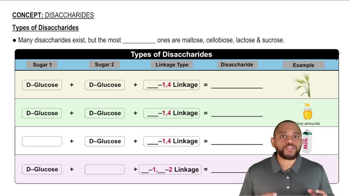
Reducing disaccharides, such as lactose and maltose, contain free aldehyde or ketone groups that can donate electrons to other molecules, thus reducing them. This property allows them to participate in redox reactions, which is a key characteristic in biochemical processes. The presence of a hemiacetal or free anomeric carbon in their structure is what enables this reducing capability.
Recommended video:
Guided course
3:39
Types of Disaccharides Concept 1

Nonreducing Disaccharides

Nonreducing disaccharides, like sucrose, do not have a free aldehyde or ketone group available for reduction. In sucrose, the glycosidic bond forms between the anomeric carbons of glucose and fructose, effectively blocking the potential for oxidation. This structural feature means that sucrose cannot act as a reducing agent in biochemical reactions.
Recommended video:
Guided course
3:39
Types of Disaccharides Concept 1

Glycosidic Bond

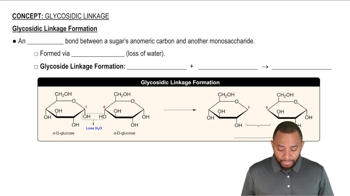
A glycosidic bond is a type of covalent bond that links monosaccharides together to form disaccharides and polysaccharides. The formation of this bond involves a condensation reaction, where a water molecule is released. The nature of the glycosidic bond, particularly whether it involves an anomeric carbon, determines whether the resulting disaccharide is reducing or nonreducing.
Recommended video:
Guided course
1:44
Glycosidic Linkage Formation Concept 1