Trehalose, a disaccharide found in the blood of insects, has the following structure. What simple sugars would you obtain on hydrolysis of trehalose? (Hint: Rotate one of the rings in your head or redraw it rotated.)
Ch.20 Carbohydrates
Chapter 20, Problem 83
Describe the differences between mono-, di-, and polysaccharides.
Verified step by step guidance1
Monosaccharides are the simplest form of carbohydrates and consist of a single sugar unit. Examples include glucose (C₆H₁₂O₆) and fructose. They are the building blocks for more complex carbohydrates.
Disaccharides are carbohydrates composed of two monosaccharide units joined together by a glycosidic bond. Examples include sucrose (table sugar), which is made of glucose and fructose, and lactose, which is made of glucose and galactose.
Polysaccharides are complex carbohydrates made up of many monosaccharide units linked together in long chains. Examples include starch, glycogen, and cellulose. These serve as energy storage (e.g., starch in plants, glycogen in animals) or structural components (e.g., cellulose in plant cell walls).
The key difference lies in their structure: monosaccharides are single units, disaccharides are two units, and polysaccharides are long chains of units. This structural difference also affects their properties, such as solubility and digestibility.
In terms of function, monosaccharides are quick energy sources, disaccharides provide slightly more complex energy storage, and polysaccharides serve as long-term energy reserves or structural materials in organisms.

Verified video answer for a similar problem:
This video solution was recommended by our tutors as helpful for the problem above.
Video duration:
4mWas this helpful?
Key Concepts
Here are the essential concepts you must grasp in order to answer the question correctly.
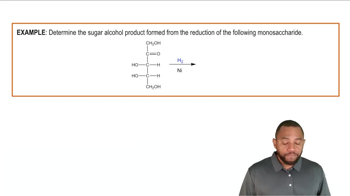
Monosaccharides
Monosaccharides are the simplest form of carbohydrates, consisting of single sugar molecules. They serve as the building blocks for more complex carbohydrates and include glucose, fructose, and galactose. These sugars are easily absorbed by the body and provide quick energy.
Recommended video:
Guided course
Reduction of Monosaccharides Example 1
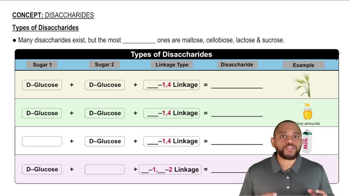
Disaccharides
Disaccharides are carbohydrates formed by the combination of two monosaccharide molecules through a glycosidic bond. Common examples include sucrose (table sugar), lactose (milk sugar), and maltose. They are broken down into their monosaccharide components during digestion before being utilized for energy.
Recommended video:
Guided course
Types of Disaccharides Concept 1
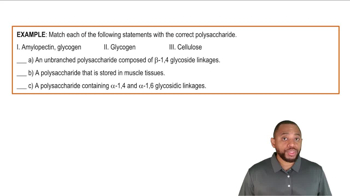
Polysaccharides
Polysaccharides are complex carbohydrates composed of long chains of monosaccharide units linked together. They serve various functions, such as energy storage (e.g., starch in plants and glycogen in animals) and structural support (e.g., cellulose in plant cell walls). Due to their complexity, they are digested more slowly than monosaccharides and disaccharides.
Recommended video:
Guided course
Polysaccharides Example 1
Related Practice
Textbook Question
1111
views
Textbook Question
Are the α and β forms of the disaccharide lactose enantiomers of each other? Why or why not?
998
views
Textbook Question
D-Fructose can form a six-membered cyclic hemiacetal as well as the more prevalent five-membered cyclic form. Draw the α isomer of D-fructose in the six-membered ring.
527
views
Textbook Question
Name a naturally occurring carbohydrate and its source for each type of carbohydrate listed in Problem 20.83.
658
views
Textbook Question
Carbohydrates provide 4 kcal per gram. If a person eats 200 g per day of digestible carbohydrates, what percentage of a 2000 kcal daily diet would be digestible carbohydrate?
743
views