Pearson+ LogoPearson+ Logo
Ch.23 Lipids
McMurry - Fundamentals of GOB 8th Edition
McMurry8th EditionFundamentals of GOBISBN: 9780134015187Not the one you use?Change textbook
Chapter 23, Problem 74c

Based on the information in Section 23.7, how would you expect each of these common metabolites to cross the cell membrane?
c. Ca2+

Verified step by step guidance
1
Understand the nature of the metabolite: Calcium ions (Ca2+) are charged particles, making them polar and unable to diffuse directly through the hydrophobic lipid bilayer of the cell membrane.
Recall the mechanism for charged particles crossing the membrane: Charged ions like Ca2+ require specific transport mechanisms, such as ion channels or transport proteins, to move across the membrane.
Identify the specific transport mechanism: Ca2+ typically crosses the membrane through calcium ion channels or active transport mechanisms like calcium pumps, which are proteins embedded in the membrane.
Consider the energy requirement: If the movement of Ca2+ is against its concentration gradient, active transport will be required, which uses energy in the form of ATP. If it moves down its concentration gradient, facilitated diffusion through ion channels may occur.
Summarize the process: Ca2+ crosses the cell membrane via specialized protein channels or pumps, depending on the direction of movement relative to its concentration gradient and the energy requirements.

Verified video answer for a similar problem:

This video solution was recommended by our tutors as helpful for the problem above.
Video duration:
3m
Was this helpful?

Key Concepts

Here are the essential concepts you must grasp in order to answer the question correctly.

Cell Membrane Structure

The cell membrane is primarily composed of a phospholipid bilayer, which creates a semi-permeable barrier. This structure allows certain molecules to pass through while restricting others based on size, charge, and polarity. Understanding this structure is crucial for predicting how different metabolites, like Ca<sup>2+</sup>, can cross the membrane.
Recommended video:
Guided course
1:00
Cell Membranes Example 1

Ion Channels and Transporters

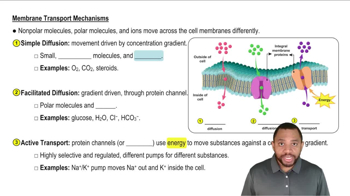
Ions such as Ca<sup>2+</sup> typically require specific ion channels or transporters to cross the cell membrane due to their charge and size. These proteins facilitate the movement of ions across the membrane, often in response to concentration gradients or electrical signals, which is essential for cellular functions like signaling and muscle contraction.
Recommended video:
Guided course
3:01
Membrane Transport Concept 2

Active vs. Passive Transport

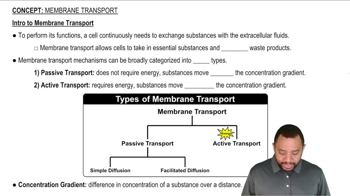
Transport mechanisms can be classified as active or passive. Passive transport does not require energy and occurs along concentration gradients, while active transport requires energy to move substances against their gradients. Understanding these mechanisms is vital for predicting how Ca<sup>2+</sup> enters or exits cells, especially in processes like muscle contraction and neurotransmitter release.
Recommended video:
Guided course
1:21
Membrane Transport Concept 1