Pearson+ LogoPearson+ Logo
Ch.23 Lipids
McMurry - Fundamentals of GOB 8th Edition
McMurry8th EditionFundamentals of GOBISBN: 9780134015187Not the one you use?Change textbook
Chapter 23, Problem 2

One of the constituents of the carnauba wax used in floor and furniture polish is an ester of a 32-carbon straight-chain alcohol with a C20:0 straight-chain carboxylic acid. Draw the structure of this ester. (Use subscripts to show the numbers of connected CH2 groups.)

Verified step by step guidance
1
Understand the problem: The ester is formed by the reaction of a 32-carbon straight-chain alcohol and a 20-carbon straight-chain carboxylic acid. Esters are formed through a condensation reaction between an alcohol and a carboxylic acid, releasing water.
Write the general formula for an ester: The ester functional group is represented as RCOOR', where R is the alkyl group from the carboxylic acid and R' is the alkyl group from the alcohol.
Identify the alcohol: The alcohol is a 32-carbon straight-chain alcohol, which can be written as CH₃(CH₂)₃₀CH₂OH. This structure includes a hydroxyl group (-OH) attached to the terminal carbon of the chain.
Identify the carboxylic acid: The carboxylic acid is a 20-carbon straight-chain acid, which can be written as CH₃(CH₂)₁₈COOH. This structure includes a carboxyl group (-COOH) at the terminal carbon of the chain.
Combine the alcohol and carboxylic acid to form the ester: The hydroxyl group (-OH) from the alcohol reacts with the carboxyl group (-COOH) from the acid, forming an ester bond (-COO-) and releasing water. The resulting ester structure is CH₃(CH₂)₁₈COOCH₂(CH₂)₃₀CH₃.

Verified video answer for a similar problem:

This video solution was recommended by our tutors as helpful for the problem above.
Video duration:
3m
Was this helpful?

Key Concepts

Here are the essential concepts you must grasp in order to answer the question correctly.

Ester Formation

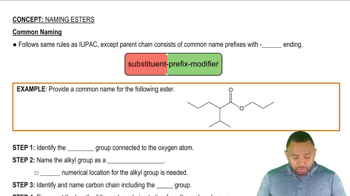
Ester formation is a chemical reaction between an alcohol and a carboxylic acid, resulting in the creation of an ester and water. In this case, the ester is formed from a 32-carbon straight-chain alcohol and a C20:0 straight-chain carboxylic acid. Understanding this process is crucial for drawing the correct structure of the ester.
Recommended video:
Guided course
3:30
Common Naming: Esters Concept 2

Structural Representation of Organic Compounds

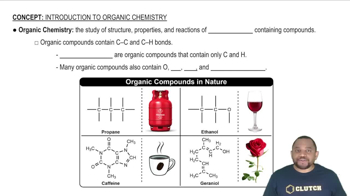
Organic compounds are often represented using structural formulas that depict the arrangement of atoms. In this context, it is important to accurately represent the long carbon chains and functional groups, such as the ester linkage, to convey the molecular structure clearly. Using subscripts to indicate the number of CH₂ groups helps in visualizing the carbon backbone.
Recommended video:
Guided course
2:26
Introduction to Organic Chemistry Concept 1

Fatty Acids and Alcohols

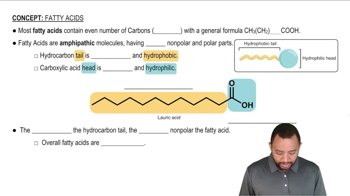
Fatty acids are carboxylic acids with long hydrocarbon chains, while alcohols are organic compounds containing hydroxyl (-OH) groups. The specific fatty acid mentioned, C20:0, indicates a saturated fatty acid with 20 carbon atoms, which is essential for understanding the properties of the ester formed with the 32-carbon alcohol. Recognizing the characteristics of these components aids in predicting the behavior and structure of the resulting ester.
Recommended video:
Guided course
2:00
Fatty Acids Concept 1