Pearson+ LogoPearson+ Logo
Ch.23 Lipids
McMurry - Fundamentals of GOB 8th Edition
McMurry8th EditionFundamentals of GOBISBN: 9780134015187Not the one you use?Change textbook
Chapter 23, Problem 6

Can there be any chiral carbon atoms in triacylglycerols? If so, which ones can be chiral and what determines their chirality?

Verified step by step guidance
1
Triacylglycerols are esters formed from glycerol and three fatty acid molecules. Glycerol is a three-carbon molecule with the formula C₃H₈O₃, where each carbon is bonded to a hydroxyl (-OH) group.
To determine if a carbon atom in a molecule is chiral, it must be bonded to four different groups. A chiral carbon is also referred to as an asymmetric carbon.
In triacylglycerols, the central carbon atom of the glycerol backbone (C₂) can potentially be chiral. This is because, after esterification with fatty acids, the groups attached to this carbon may differ depending on the fatty acids involved.
If the three fatty acids attached to the glycerol backbone are not identical (e.g., one saturated, one monounsaturated, and one polyunsaturated), the central carbon (C₂) will have four different groups attached, making it a chiral center.
The chirality of the central carbon is determined by the specific fatty acids attached to the glycerol backbone. If all three fatty acids are identical, the central carbon will not be chiral because it will not have four distinct groups.

Verified video answer for a similar problem:

This video solution was recommended by our tutors as helpful for the problem above.
Video duration:
1m
Was this helpful?

Key Concepts

Here are the essential concepts you must grasp in order to answer the question correctly.

Chirality

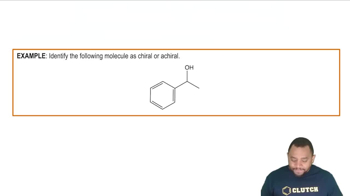
Chirality refers to the geometric property of a molecule that makes it non-superimposable on its mirror image, much like left and right hands. A chiral carbon atom is one that is bonded to four different substituents, leading to two distinct enantiomers. This property is crucial in biochemistry, as the chirality of molecules can significantly affect their biological activity.
Recommended video:
Guided course
1:39
Chirality Example 1

Triacylglycerols

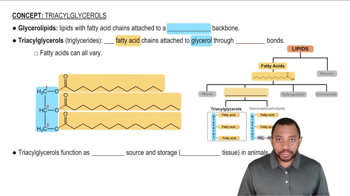
Triacylglycerols, also known as triglycerides, are esters formed from glycerol and three fatty acids. They serve as a major form of energy storage in organisms. The structure of triacylglycerols can vary based on the types of fatty acids attached, which can influence the presence of chiral centers within the molecule.
Recommended video:
Guided course
1:52
Triacylglycerols Concept 1

Determining Chirality in Triacylglycerols

In triacylglycerols, chirality can arise from the glycerol backbone if it is esterified with fatty acids that differ in structure. Specifically, if one of the fatty acids is unsaturated or has a unique configuration, it can create a chiral center at the glycerol carbon. The presence of chiral centers is determined by the diversity of the substituents attached to the carbon atoms.
Recommended video:
Guided course
1:39
Chirality Example 1