One of the constituents of the carnauba wax used in floor and furniture polish is an ester of a 32-carbon straight-chain alcohol with a C20:0 straight-chain carboxylic acid. Draw the structure of this ester. (Use subscripts to show the numbers of connected CH2 groups.)
Ch.23 Lipids
Chapter 23, Problem 8
Write an equation for the complete hydrogenation of triolein, the triacylglycerol with three oleic acid acyl groups for which you drew the structure in Problem 23.3. Name the fatty acid from which the resulting acyl groups are derived.
Verified step by step guidance1
Identify the structure of triolein: Triolein is a triacylglycerol composed of glycerol esterified with three oleic acid molecules. Oleic acid is a monounsaturated fatty acid with the formula C₁₈H₃₄O₂, containing one double bond in its hydrocarbon chain.
Understand the process of hydrogenation: Complete hydrogenation involves the addition of hydrogen (H₂) across the double bonds in the unsaturated fatty acid chains, converting them into saturated fatty acid chains. This reaction is typically catalyzed by a metal catalyst such as nickel (Ni).
Write the chemical equation for the hydrogenation reaction: Represent triolein as C₅₇H₁₀₄O₆ (the molecular formula for a triacylglycerol with three oleic acid groups). Add three molecules of hydrogen (H₂) for each double bond present in the triolein molecule. The product will be a triacylglycerol with three stearic acid groups, as the double bonds are fully saturated.
Express the reaction in equation form:
Name the resulting fatty acid: The resulting acyl groups are derived from stearic acid, a saturated fatty acid with the formula C₁₈H₃₆O₂. Stearic acid is the fully hydrogenated form of oleic acid.

Verified video answer for a similar problem:
This video solution was recommended by our tutors as helpful for the problem above.
Video duration:
5mWas this helpful?
Key Concepts
Here are the essential concepts you must grasp in order to answer the question correctly.
Triolein Structure
Triolein is a triacylglycerol composed of three oleic acid molecules. Each oleic acid contributes a long hydrocarbon chain with a double bond, making triolein unsaturated. Understanding its structure is crucial for predicting the products of hydrogenation, which involves the addition of hydrogen to the double bonds, converting them into single bonds.
Recommended video:
Guided course
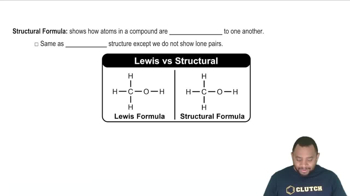
Structural Formula Concept 2
Hydrogenation Process
Hydrogenation is a chemical reaction that involves the addition of hydrogen (H2) to unsaturated fats, resulting in the conversion of double bonds to single bonds. This process typically occurs in the presence of a catalyst, such as nickel or platinum, and is used to solidify liquid oils. In the case of triolein, complete hydrogenation will yield a saturated fat, specifically tristearin.
Recommended video:
Guided course
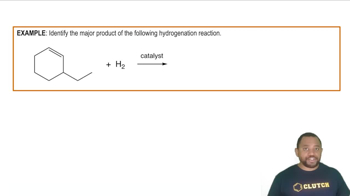
Hydrogenation Reactions Example 1
Fatty Acid Derivation
The fatty acids derived from the hydrogenation of triolein are saturated fatty acids. In this case, the resulting acyl groups after complete hydrogenation are derived from stearic acid, which has a straight-chain structure with no double bonds. Recognizing the relationship between the original unsaturated fatty acids and the resulting saturated fatty acids is essential for naming and understanding the products of the reaction.
Recommended video:
Guided course
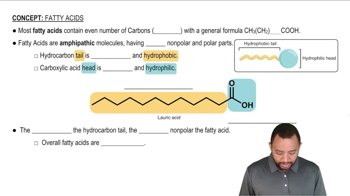
Fatty Acids Concept 1
Related Practice
Textbook Question
984
views
Textbook Question
Draw the complete structural formula of arachidonic acid (Table 23.1) in a way that shows the cis stereochemistry of its four double bonds.
714
views
Textbook Question
Can there be any chiral carbon atoms in triacylglycerols? If so, which ones can be chiral and what determines their chirality?
1338
views
Textbook Question
Write the complete equation for the hydrolysis of a triacylglycerol in which the fatty acids are two molecules of stearic acid and one of oleic acid.
731
views
Textbook Question
Identify the products formed by complete hydrolysis of all ester bonds in (a) the phosphatidylcholine on page 726.
723
views
Textbook Question
Identify the products formed by complete hydrolysis of all ester bonds in (b) the sphingomyelin in Figure 23.5.
739
views