


Pearson+ LogoPearson+ Logo
Ch.25 Protein and Amino Acid Metabolism
McMurry - Fundamentals of GOB 8th Edition
McMurry8th EditionFundamentals of GOBISBN: 9780134015187Not the one you use?Change textbook
Chapter 25, Problem 8

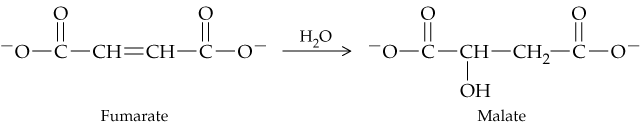
Fumarate from step 3 of the urea cycle may be recycled into aspartate for use in step 2 of the cycle. The sequence of reactions for this process is
a.
b.
c.
Classify each reaction as one of the following:
1. Oxidation
2. Reduction
3. Transamination
4. Elimination
5. Addition

Verified step by step guidance
1
Step 1: Understand the context of the problem. The urea cycle is a metabolic pathway that converts ammonia into urea for excretion. Fumarate is an intermediate that can be recycled into aspartate, which is used in another step of the cycle. The problem asks us to classify each reaction in the sequence based on the type of chemical transformation occurring.
Step 2: Review the definitions of the reaction types provided: (1) Oxidation involves the loss of electrons or an increase in oxidation state, (2) Reduction involves the gain of electrons or a decrease in oxidation state, (3) Transamination involves the transfer of an amino group between molecules, (4) Elimination involves the removal of a group to form a double bond or a ring, and (5) Addition involves the addition of a group to a molecule, often across a double bond.
Step 3: Analyze each reaction in the sequence. For each reaction, identify the reactants and products, and determine what type of transformation has occurred. For example, if a molecule loses hydrogen atoms, it is likely an oxidation reaction. If an amino group is transferred, it is a transamination reaction.
Step 4: Match each reaction to the appropriate classification based on the chemical changes observed. For instance, if a double bond is formed by removing a group, classify it as an elimination reaction. If a group is added to a molecule, classify it as an addition reaction.
Step 5: Summarize your findings by listing each reaction in the sequence along with its classification. Ensure that your classifications align with the definitions provided and the observed chemical transformations in the reactions.

Verified video answer for a similar problem:

This video solution was recommended by our tutors as helpful for the problem above.
Video duration:
2m
Was this helpful?

Key Concepts

Here are the essential concepts you must grasp in order to answer the question correctly.

Urea Cycle

The urea cycle is a series of biochemical reactions that convert ammonia, a toxic byproduct of protein metabolism, into urea, which can be excreted from the body. This cycle occurs primarily in the liver and involves several key intermediates, including fumarate and aspartate. Understanding the urea cycle is essential for grasping how nitrogen is processed and eliminated in the body.
Recommended video:
Guided course
0:51
The Urea Cycle Concept 3

Transamination

Transamination is a chemical reaction that involves the transfer of an amino group from one amino acid to a keto acid, forming a new amino acid and a new keto acid. This process is crucial in amino acid metabolism and is a key step in the urea cycle, particularly in the conversion of fumarate to aspartate. Recognizing transamination helps in understanding how amino acids are synthesized and degraded.
Recommended video:
Guided course
3:03
Amino Acid Catabolism: Amino Group Example 2

Oxidation and Reduction Reactions

Oxidation and reduction (redox) reactions are fundamental chemical processes where electrons are transferred between substances. Oxidation refers to the loss of electrons, while reduction involves the gain of electrons. In the context of the urea cycle, these reactions are important for understanding how energy is produced and how metabolic intermediates are transformed, impacting the overall efficiency of the cycle.
Recommended video:
Guided course
2:38
Reduction Reactions Concept 1