Pearson+ LogoPearson+ Logo
Ch.25 Protein and Amino Acid Metabolism
McMurry - Fundamentals of GOB 8th Edition
McMurry8th EditionFundamentals of GOBISBN: 9780134015187Not the one you use?Change textbook
Chapter 25, Problem 14

Three metabolites that can result from the breakdown of the carbon skeleton of amino acids are ketone bodies, acetyl-CoA, and glucose. Briefly describe how each of these metabolites can be produced from amino acid catabolism.

Verified step by step guidance
1
Amino acids are first deaminated, meaning their amino group (-NH2) is removed, leaving behind a carbon skeleton. This carbon skeleton can then enter various metabolic pathways depending on its structure.
Ketone bodies are produced when the carbon skeletons of ketogenic amino acids are converted into intermediates like acetoacetate or beta-hydroxybutyrate. These intermediates are formed during ketogenesis, which occurs in the liver, especially under conditions of low carbohydrate availability (e.g., fasting).
Acetyl-CoA is formed when the carbon skeletons of certain amino acids (both ketogenic and glucogenic) are broken down into two-carbon units. These units are then combined with coenzyme A to form acetyl-CoA, which can enter the citric acid cycle or be used for fatty acid synthesis.
Glucose is produced from the carbon skeletons of glucogenic amino acids through gluconeogenesis. These amino acids are converted into intermediates of the citric acid cycle (e.g., oxaloacetate) or other gluconeogenic precursors, which are then used to synthesize glucose in the liver or kidneys.
The specific pathway (ketone body formation, acetyl-CoA production, or glucose synthesis) depends on the type of amino acid (ketogenic, glucogenic, or both) and the metabolic needs of the body at the time of catabolism.

Verified video answer for a similar problem:

This video solution was recommended by our tutors as helpful for the problem above.
Video duration:
2m
Was this helpful?

Key Concepts

Here are the essential concepts you must grasp in order to answer the question correctly.

Amino Acid Catabolism

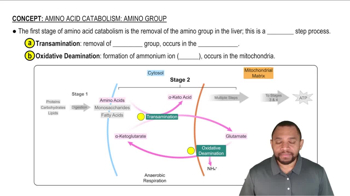
Amino acid catabolism refers to the metabolic process where amino acids are broken down to produce energy or convert into other compounds. This process involves deamination, where the amino group is removed, allowing the carbon skeleton to enter various metabolic pathways, ultimately leading to the production of key metabolites like glucose, acetyl-CoA, and ketone bodies.
Recommended video:
Guided course
2:21
Amino Acid Catabolism: Amino Group Concept 1

Acetyl-CoA Production

Acetyl-CoA is a central metabolite in energy production and biosynthesis. It can be produced from the breakdown of certain amino acids through a process called oxidative deamination, where the carbon skeleton is converted into acetyl-CoA, which then enters the citric acid cycle to generate ATP or serve as a building block for fatty acid synthesis.
Recommended video:
Guided course
01:37
Solubility Product Constant (Ksp) Concept 2

Ketone Bodies

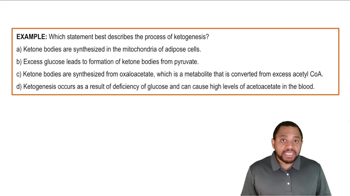
Ketone bodies are water-soluble molecules produced in the liver from fatty acids and, to a lesser extent, from the catabolism of certain amino acids. During periods of low carbohydrate availability, such as fasting or prolonged exercise, amino acids can be converted into acetoacetate and beta-hydroxybutyrate, which serve as alternative energy sources for tissues, particularly the brain.
Recommended video:
Guided course
1:41
Ketone Bodies Example 1