
Pearson+ LogoPearson+ Logo
Ch.25 Protein and Amino Acid Metabolism
McMurry - Fundamentals of GOB 8th Edition
McMurry8th EditionFundamentals of GOBISBN: 9780134015187Not the one you use?Change textbook
Chapter 25, Problem 16

In the liver, the relative activity of ornithine transcarbamylase is high, that of argininosuccinate synthetase is low, and that of arginase is high. Why is it important that ornithine transcarbamylase activity be high in the liver? What might be the consequence if arginase activity is low or defective?

Verified step by step guidance
1
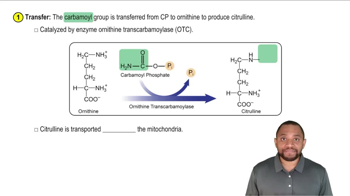
Understand the role of ornithine transcarbamylase: This enzyme is a key component of the urea cycle, which occurs in the liver. Its primary function is to catalyze the reaction between carbamoyl phosphate and ornithine to form citrulline. This step is crucial for the removal of excess nitrogen from the body in the form of urea.
Explain why high ornithine transcarbamylase activity is important: High activity ensures efficient conversion of carbamoyl phosphate and ornithine into citrulline, preventing the accumulation of toxic ammonia in the body. Ammonia is a byproduct of amino acid metabolism, and its buildup can lead to hyperammonemia, a potentially life-threatening condition.
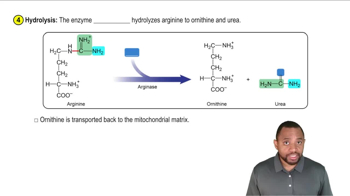
Understand the role of arginase: Arginase is the final enzyme in the urea cycle. It catalyzes the hydrolysis of arginine to produce urea and ornithine. Urea is then excreted from the body, while ornithine is recycled back into the cycle.
Discuss the consequences of low or defective arginase activity: If arginase activity is low or defective, the urea cycle cannot efficiently produce urea. This leads to the accumulation of arginine and ammonia in the body, causing hyperammonemia and related symptoms such as lethargy, vomiting, and in severe cases, neurological damage.
Summarize the importance of enzyme activity balance: The urea cycle relies on the coordinated activity of its enzymes. High ornithine transcarbamylase activity ensures the cycle starts efficiently, while proper arginase activity ensures the cycle completes effectively. Any imbalance can disrupt nitrogen metabolism and lead to toxic effects.

Verified video answer for a similar problem:

This video solution was recommended by our tutors as helpful for the problem above.
Video duration:
6m
Was this helpful?

Key Concepts

Here are the essential concepts you must grasp in order to answer the question correctly.

Ornithine Transcarbamylase (OTC)

Ornithine transcarbamylase is an enzyme in the urea cycle that catalyzes the conversion of ornithine and carbamoyl phosphate into citrulline. High activity of OTC in the liver is crucial for efficiently processing excess nitrogen from amino acid metabolism, preventing toxic accumulation of ammonia in the bloodstream.
Recommended video:
Guided course
1:12
The Urea Cycle Concept 4

Urea Cycle

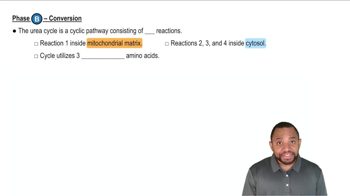
The urea cycle is a series of biochemical reactions in the liver that convert ammonia, a toxic byproduct of protein metabolism, into urea, which is excreted in urine. The cycle involves several key enzymes, including OTC, argininosuccinate synthetase, and arginase, and is essential for maintaining nitrogen balance in the body.
Recommended video:
Guided course
0:51
The Urea Cycle Concept 3

Arginase

Arginase is an enzyme that catalyzes the final step of the urea cycle, converting arginine into urea and ornithine. If arginase activity is low or defective, it can lead to the accumulation of arginine and ammonia, resulting in hyperammonemia, which can cause neurological damage and other serious health issues.
Recommended video:
Guided course
1:31
The Urea Cycle Concept 7