
Pearson+ LogoPearson+ Logo
Ch.25 Protein and Amino Acid Metabolism
McMurry - Fundamentals of GOB 8th Edition
McMurry8th EditionFundamentals of GOBISBN: 9780134015187Not the one you use?Change textbook
Chapter 25, Problem 3

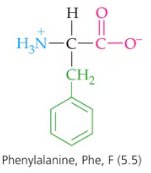
What is the structure of the α-keto acid formed by transamination of the amino acid phenylalanine (Phe)?
Structure of α-keto acid from transamination of phenylalanine, showing amino and carboxyl groups.

Verified step by step guidance
1
Understand the process of transamination: Transamination is a biochemical reaction where an amino group (-NH₂) from an amino acid is transferred to an α-keto acid, resulting in the formation of a new amino acid and a new α-keto acid. In this case, we are focusing on the α-keto acid formed when phenylalanine undergoes transamination.
Identify the structure of phenylalanine: Phenylalanine (Phe) is an amino acid with the structure C₆H₅-CH₂-CH(NH₂)-COOH. It contains a benzyl side chain (C₆H₅-CH₂) attached to the α-carbon, which is also bonded to an amino group (-NH₂) and a carboxylic acid group (-COOH).
Determine the α-keto acid product: During transamination, the amino group (-NH₂) on the α-carbon of phenylalanine is replaced by a keto group (=O). This results in the formation of an α-keto acid. The general structure of the α-keto acid is C₆H₅-CH₂-CO-COOH.
Write the structure of the α-keto acid: The α-keto acid formed from phenylalanine is phenylpyruvic acid. Its structure is C₆H₅-CH₂-CO-COOH, where the benzyl group (C₆H₅-CH₂) remains unchanged, and the α-carbon now has a keto group (=O) instead of the amino group.
Verify the reaction: Confirm that the transamination reaction conserves the carbon skeleton of phenylalanine while replacing the amino group with a keto group. This ensures the correct α-keto acid, phenylpyruvic acid, is identified as the product.

Verified video answer for a similar problem:

This video solution was recommended by our tutors as helpful for the problem above.
Video duration:
1m
Was this helpful?

Key Concepts

Here are the essential concepts you must grasp in order to answer the question correctly.

Transamination

Transamination is a biochemical process that involves the transfer of an amino group from an amino acid to a keto acid. This reaction is crucial in amino acid metabolism, allowing the synthesis of new amino acids and the conversion of amino acids into intermediates for energy production. In the case of phenylalanine, transamination will yield a corresponding α-keto acid, which is essential for understanding its metabolic fate.
Recommended video:
Guided course
3:03
Amino Acid Catabolism: Amino Group Example 2

α-Keto Acid

An α-keto acid is a type of organic compound that contains a keto group (C=O) adjacent to a carboxylic acid group (–COOH). These compounds play a significant role in metabolism, particularly in the Krebs cycle and amino acid catabolism. The α-keto acid formed from phenylalanine through transamination is crucial for understanding its structural and functional implications in metabolic pathways.
Recommended video:

Phenylalanine Structure

Phenylalanine is an essential amino acid characterized by its aromatic side chain, which consists of a phenyl group attached to an α-carbon. Its structure is vital for understanding how it participates in transamination reactions. By referring to Table 18.3, one can visualize the specific arrangement of atoms in phenylalanine, which directly influences the structure of the resulting α-keto acid after the transamination process.
Recommended video:
Guided course
1:01
Structural Formula Concept 2