Pearson+ LogoPearson+ Logo
Ch.25 Protein and Amino Acid Metabolism
McMurry - Fundamentals of GOB 8th Edition
McMurry8th EditionFundamentals of GOBISBN: 9780134015187Not the one you use?Change textbook
Chapter 25, Problem 25

In general, how does oxidative deamination differ from transamination?

Verified step by step guidance
1
Oxidative deamination and transamination are two processes involved in amino acid metabolism. Begin by understanding that both processes deal with the removal or transfer of the amino group (-NH₂) from amino acids, but they differ in their mechanisms and outcomes.
In oxidative deamination, the amino group of an amino acid is removed and converted into ammonia (NH₃). This process typically involves the oxidation of the amino acid, often catalyzed by enzymes like glutamate dehydrogenase. The reaction also produces a keto acid and requires cofactors such as NAD⁺ or NADP⁺.
In transamination, the amino group from one amino acid is transferred to a keto acid, forming a new amino acid and a new keto acid. This reaction is catalyzed by transaminase (or aminotransferase) enzymes and requires the coenzyme pyridoxal phosphate (PLP).
The key difference is that oxidative deamination results in the release of free ammonia, which can be toxic and is typically processed further in the urea cycle, while transamination does not release free ammonia but instead facilitates the interconversion of amino acids and keto acids.
To summarize, oxidative deamination is a process of amino group removal with ammonia release, while transamination is a transfer of the amino group to another molecule without releasing free ammonia. Both processes are crucial for nitrogen metabolism in the body.

Verified video answer for a similar problem:

This video solution was recommended by our tutors as helpful for the problem above.
Video duration:
6m
Was this helpful?

Key Concepts

Here are the essential concepts you must grasp in order to answer the question correctly.

Oxidative Deamination

Oxidative deamination is a biochemical process where an amino group is removed from an amino acid, resulting in the formation of a corresponding keto acid and ammonia. This reaction typically occurs in the liver and is crucial for the metabolism of amino acids, allowing the body to convert excess amino acids into energy or other compounds. The process is catalyzed by enzymes known as deaminases.

Transamination

Transamination is a process that involves the transfer of an amino group from one amino acid to a keto acid, forming a new amino acid and a new keto acid. This reaction is essential for the synthesis of non-essential amino acids and is facilitated by enzymes called transaminases or aminotransferases. Transamination plays a vital role in amino acid metabolism and nitrogen balance in the body.
Recommended video:
Guided course
3:03
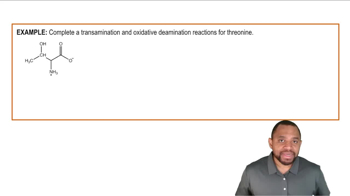
Amino Acid Catabolism: Amino Group Example 2

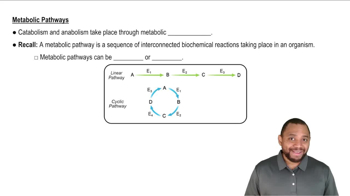
Metabolic Pathways

Metabolic pathways are series of chemical reactions occurring within a cell that lead to the conversion of substrates into products. Both oxidative deamination and transamination are integral parts of amino acid metabolism, influencing how the body utilizes proteins for energy, synthesizes new compounds, and maintains nitrogen balance. Understanding these pathways is essential for grasping how the body processes nutrients and manages waste.
Recommended video:
Guided course
0:52
Metabolic Pathways Concept 2