
Pearson+ LogoPearson+ Logo
Ch.25 Protein and Amino Acid Metabolism
McMurry - Fundamentals of GOB 8th Edition
McMurry8th EditionFundamentals of GOBISBN: 9780134015187Not the one you use?Change textbook
Chapter 25, Problem 20

What citric acid cycle intermediates are precursors to amino acids?

Verified step by step guidance
1
Understand that the citric acid cycle (also known as the Krebs cycle or TCA cycle) is a central metabolic pathway that not only generates energy but also provides intermediates for biosynthetic processes, including amino acid synthesis.
Identify the intermediates in the citric acid cycle that can serve as precursors for amino acids. These intermediates include oxaloacetate, α-ketoglutarate, and fumarate.
Explain that oxaloacetate is a precursor for aspartate, which can further lead to the synthesis of other amino acids such as asparagine, methionine, lysine, and threonine.
Explain that α-ketoglutarate is a precursor for glutamate, which can be used to synthesize other amino acids such as glutamine, proline, and arginine.
Explain that fumarate, while not directly a precursor, is part of the metabolic pathways that connect to amino acid synthesis, particularly through its role in the urea cycle and other transamination reactions.

Verified video answer for a similar problem:

This video solution was recommended by our tutors as helpful for the problem above.
Video duration:
5m
Was this helpful?

Key Concepts

Here are the essential concepts you must grasp in order to answer the question correctly.

Citric Acid Cycle (Krebs Cycle)

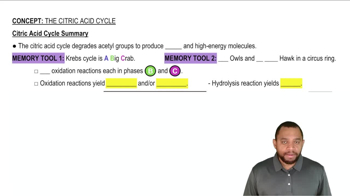
The citric acid cycle, also known as the Krebs cycle, is a series of chemical reactions used by all aerobic organisms to generate energy. It occurs in the mitochondria and involves the oxidation of acetyl-CoA to produce ATP, NADH, and FADH2. This cycle is crucial for cellular respiration and provides intermediates that serve as building blocks for various biomolecules, including amino acids.
Recommended video:
Guided course
2:31
Citric Acid Cycle Summary Concept 12

Amino Acid Biosynthesis

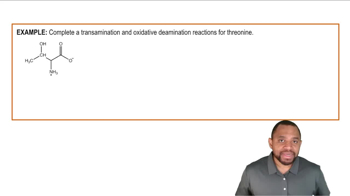
Amino acid biosynthesis refers to the process by which cells create amino acids, the building blocks of proteins. Certain intermediates from the citric acid cycle, such as α-ketoglutarate and oxaloacetate, can be converted into specific amino acids through transamination and other biochemical pathways. Understanding this relationship is essential for grasping how metabolic pathways are interconnected.
Recommended video:
Guided course
3:03
Amino Acid Catabolism: Amino Group Example 2

Metabolic Intermediates

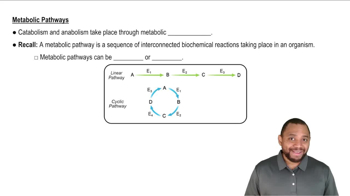
Metabolic intermediates are compounds that form during the metabolic processes of cells, acting as substrates or products in various biochemical reactions. In the context of the citric acid cycle, intermediates like citrate, α-ketoglutarate, and succinyl-CoA play pivotal roles not only in energy production but also as precursors for synthesizing amino acids and other important biomolecules, highlighting the interconnectedness of metabolism.
Recommended video:
Guided course
0:52
Metabolic Pathways Concept 2