Pearson+ LogoPearson+ Logo
Ch.25 Protein and Amino Acid Metabolism
McMurry - Fundamentals of GOB 8th Edition
McMurry8th EditionFundamentals of GOBISBN: 9780134015187Not the one you use?Change textbook
Chapter 25, Problem 23a

What is the structure of the ⍺-keto acid formed from transamination of the following amino acids?
a. Glutamic acid

Verified step by step guidance
1
Understand the concept of transamination: Transamination is a biochemical reaction where an amino group (-NH₂) from an amino acid is transferred to an α-keto acid, typically α-ketoglutarate, forming a new amino acid and a new α-keto acid. In this case, we are identifying the α-keto acid formed when glutamic acid undergoes transamination.
Identify the structure of glutamic acid: Glutamic acid is an amino acid with the structure HOOC-CH₂-CH₂-CH(NH₂)-COOH. It contains an amino group (-NH₂) attached to the α-carbon and two carboxylic acid groups (-COOH).
Determine the α-keto acid formed: During transamination, the amino group (-NH₂) on the α-carbon of glutamic acid is removed and replaced with a keto group (=O). This results in the formation of an α-keto acid. The structure of the α-keto acid will be HOOC-CH₂-CH₂-CO-COOH.
Name the α-keto acid: The α-keto acid formed from glutamic acid is α-ketoglutaric acid (also known as 2-oxoglutaric acid). This compound is a key intermediate in the citric acid cycle.
Verify the reaction: Ensure that the reaction follows the general pattern of transamination, where the amino group is transferred to another molecule (e.g., α-ketoglutarate) and the original amino acid is converted into its corresponding α-keto acid.

Verified video answer for a similar problem:

This video solution was recommended by our tutors as helpful for the problem above.
Video duration:
1m
Was this helpful?

Key Concepts

Here are the essential concepts you must grasp in order to answer the question correctly.

Transamination

Transamination is a biochemical process where an amino group from an amino acid is transferred to a keto acid, resulting in the formation of a new amino acid and a new keto acid. This reaction is crucial in amino acid metabolism and is catalyzed by enzymes known as transaminases or aminotransferases. For example, when glutamic acid undergoes transamination, it can donate its amino group to α-ketoglutarate, forming α-keto acid and another amino acid.
Recommended video:
Guided course
3:03
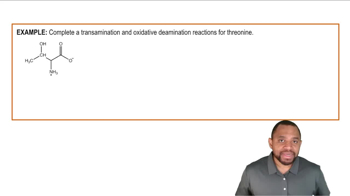
Amino Acid Catabolism: Amino Group Example 2

α-Keto Acid

An α-keto acid is a type of organic compound that contains a carbonyl group (C=O) adjacent to a carboxylic acid group (–COOH). These compounds play a significant role in metabolism, particularly in the Krebs cycle, where they serve as intermediates. The α-keto acid formed from the transamination of glutamic acid is α-ketoglutarate, which is essential for energy production and amino acid synthesis.
Recommended video:

Glutamic Acid

Glutamic acid is a non-essential amino acid that serves as a building block for proteins and plays a key role in cellular metabolism. It is involved in the synthesis of neurotransmitters and is a precursor for the formation of other amino acids. In the context of transamination, glutamic acid is often the donor of the amino group, facilitating the conversion of α-ketoglutarate into other amino acids, thus linking amino acid metabolism with energy production.
Recommended video:
Guided course
4:00
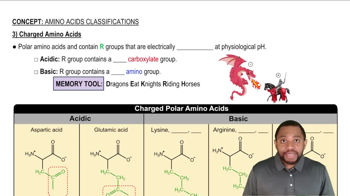
Charged Amino Acids Concept 3