Pearson+ LogoPearson+ Logo
Ch.26 Nucleic Acids and Protein Synthesis
McMurry - Fundamentals of GOB 8th Edition
McMurry8th EditionFundamentals of GOBISBN: 9780134015187Not the one you use?Change textbook
Chapter 26, Problem 32a

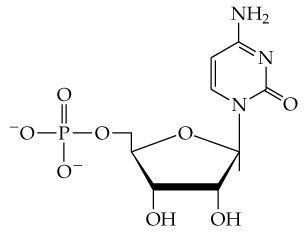
For the following molecule:

a. Label the three nucleic acid building blocks it contains.

Verified step by step guidance
1
Identify the three main components of a nucleic acid building block: (1) a phosphate group, (2) a sugar (either ribose or deoxyribose), and (3) a nitrogenous base (adenine, thymine, cytosine, guanine, or uracil).
Examine the molecular structure in the image provided. Locate the phosphate group, which is typically represented as a phosphorus atom bonded to four oxygen atoms.
Next, identify the sugar molecule. Look for a five-carbon ring structure (pentose sugar). Determine whether it is ribose (with an -OH group on the 2' carbon) or deoxyribose (with an -H on the 2' carbon).
Locate the nitrogenous base attached to the sugar. It will be a ring structure containing nitrogen atoms. Classify it as a purine (adenine or guanine, which have two rings) or a pyrimidine (cytosine, thymine, or uracil, which have one ring).
Label each of the three components (phosphate group, sugar, and nitrogenous base) on the molecule in the image. Ensure that all three nucleic acid building blocks are clearly identified and labeled.

Verified video answer for a similar problem:

This video solution was recommended by our tutors as helpful for the problem above.
Video duration:
1m
Was this helpful?

Key Concepts

Here are the essential concepts you must grasp in order to answer the question correctly.

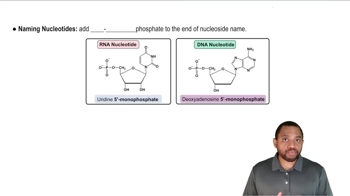
Nucleotides

Nucleotides are the basic building blocks of nucleic acids, consisting of three components: a phosphate group, a five-carbon sugar, and a nitrogenous base. They link together to form the backbone of DNA and RNA, with the sequence of nitrogenous bases encoding genetic information.
Recommended video:
Guided course
1:21
Naming Nucleosides and Nucleotides Concept 2

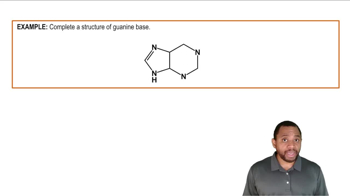
Nitrogenous Bases

Nitrogenous bases are organic molecules that contain nitrogen and are a key part of nucleotides. In DNA, the bases are adenine (A), thymine (T), cytosine (C), and guanine (G), while in RNA, uracil (U) replaces thymine. The specific pairing of these bases (A with T, and C with G) is crucial for the structure and function of nucleic acids.
Recommended video:
Guided course
1:23
Nitrogenous Bases Example 3

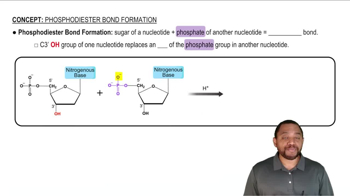
Phosphodiester Bond

Phosphodiester bonds are the covalent linkages that connect the phosphate group of one nucleotide to the sugar of another, forming the sugar-phosphate backbone of nucleic acids. This bond is essential for the stability and integrity of the nucleic acid structure, allowing for the formation of long chains that carry genetic information.
Recommended video:
Guided course
2:19
Phosphodiester Bond Formation Concept 1