Pearson+ LogoPearson+ Logo
Ch.26 Nucleic Acids and Protein Synthesis
McMurry - Fundamentals of GOB 8th Edition
McMurry8th EditionFundamentals of GOBISBN: 9780134015187Not the one you use?Change textbook
Chapter 26, Problem 33

What are the sugars in DNA and RNA, and how do they differ?

Verified step by step guidance
1
Identify the sugar present in DNA: The sugar in DNA is deoxyribose, which is a five-carbon sugar (pentose) with the chemical formula C₅H₁₀O₄. It lacks an oxygen atom on the 2' carbon, hence the name 'deoxy'.
Identify the sugar present in RNA: The sugar in RNA is ribose, which is also a five-carbon sugar (pentose) but has the chemical formula C₅H₁₀O₅. It contains a hydroxyl group (-OH) on the 2' carbon.
Compare the structures of deoxyribose and ribose: Deoxyribose has a hydrogen atom (H) on the 2' carbon, while ribose has a hydroxyl group (-OH) on the 2' carbon. This structural difference is key to their distinct roles in DNA and RNA.
Explain the functional significance of the difference: The absence of the hydroxyl group in deoxyribose makes DNA more chemically stable, which is important for its role in long-term genetic storage. The presence of the hydroxyl group in ribose makes RNA more reactive and suitable for its roles in protein synthesis and other cellular processes.
Summarize the key difference: DNA contains deoxyribose, which is less reactive due to the absence of the 2' hydroxyl group, while RNA contains ribose, which is more reactive due to the presence of the 2' hydroxyl group.

Verified video answer for a similar problem:

This video solution was recommended by our tutors as helpful for the problem above.
Video duration:
1m
Was this helpful?

Key Concepts

Here are the essential concepts you must grasp in order to answer the question correctly.

Nucleotides

Nucleotides are the building blocks of nucleic acids like DNA and RNA. Each nucleotide consists of a sugar, a phosphate group, and a nitrogenous base. The sugar component varies between DNA and RNA, which is crucial for their structural differences and functions.
Recommended video:
Guided course
1:21
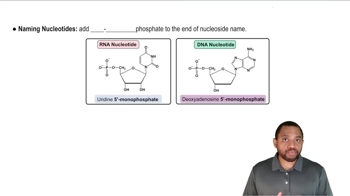
Naming Nucleosides and Nucleotides Concept 2

Deoxyribose vs. Ribose

The primary difference between DNA and RNA sugars lies in their structure: DNA contains deoxyribose, which lacks one oxygen atom compared to ribose found in RNA. This subtle difference affects the stability and reactivity of the nucleic acids, influencing their roles in genetic information storage and protein synthesis.
Recommended video:
Guided course
3:33
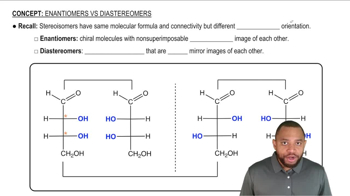
Enantiomers vs Diastereomers Concept 1

Function of Sugars in Nucleic Acids

The sugars in DNA and RNA play a vital role in the overall structure and function of these molecules. In DNA, deoxyribose contributes to the double-helix structure, while ribose in RNA allows for more flexibility, enabling various forms like mRNA, tRNA, and rRNA, which are essential for protein synthesis.
Recommended video:
Guided course
1:55
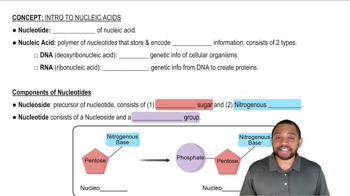
Intro to Nucleic Acids Concept 1