Pearson+ LogoPearson+ Logo
Ch.26 Nucleic Acids and Protein Synthesis
McMurry - Fundamentals of GOB 8th Edition
McMurry8th EditionFundamentals of GOBISBN: 9780134015187Not the one you use?Change textbook
Chapter 26, Problem 34a

What are the four major heterocyclic bases in DNA?

Verified step by step guidance
1
Understand that DNA (deoxyribonucleic acid) is composed of nucleotides, each of which contains a sugar, a phosphate group, and a nitrogenous base. The nitrogenous bases are the key components being asked about in this problem.
Recognize that the nitrogenous bases in DNA are heterocyclic, meaning they contain rings with at least one atom other than carbon (e.g., nitrogen).
Recall that there are four major nitrogenous bases in DNA, which are divided into two categories: purines and pyrimidines.
Identify the purines in DNA: adenine (A) and guanine (G). These are larger, double-ring structures.
Identify the pyrimidines in DNA: cytosine (C) and thymine (T). These are smaller, single-ring structures.

Verified video answer for a similar problem:

This video solution was recommended by our tutors as helpful for the problem above.
Video duration:
3m
Was this helpful?

Key Concepts

Here are the essential concepts you must grasp in order to answer the question correctly.

Heterocyclic Bases

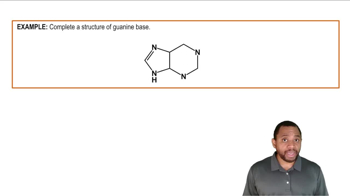
Heterocyclic bases are nitrogen-containing compounds that form the building blocks of nucleic acids like DNA and RNA. In DNA, these bases are crucial for encoding genetic information and consist of two types: purines and pyrimidines. The four major bases in DNA are adenine, thymine, cytosine, and guanine, each playing a specific role in base pairing and the overall structure of the DNA molecule.
Recommended video:
Guided course
1:23
Nitrogenous Bases Example 3

Base Pairing

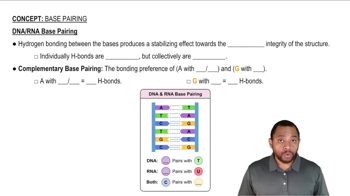
Base pairing refers to the specific hydrogen bonding between the nitrogenous bases in DNA, which is essential for the double helix structure. Adenine pairs with thymine (A-T) through two hydrogen bonds, while guanine pairs with cytosine (G-C) through three hydrogen bonds. This complementary pairing ensures accurate replication and transcription of genetic information, maintaining the integrity of the genetic code.
Recommended video:
Guided course
2:56
Base Pairing Concept 1

DNA Structure

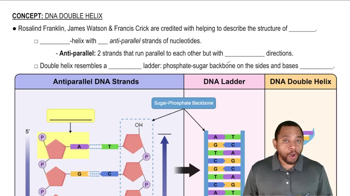
The structure of DNA is characterized by its double helix formation, consisting of two strands that wind around each other. Each strand is made up of a sugar-phosphate backbone and attached nitrogenous bases. The arrangement of these bases along the strands encodes genetic information, while the helical structure allows for compact storage and efficient replication during cell division.
Recommended video:
Guided course
3:27
DNA Double Helix Concept 1