Pearson+ LogoPearson+ Logo
Ch.10 Acids and Bases and Equilibrium
Timberlake - Chemistry: An Introduction to General, Organic, and Biological Chemistry 14th Edition
Timberlake14thChemistry: An Introduction to General, Organic, and Biological ChemistryISBN: 9781292472249Not the one you use?Change textbook
Chapter 10, Problem 35

Why does a neutral solution have a pH of 7.0?

Verified step by step guidance
1
Understand the concept of pH: pH is a measure of the hydrogen ion concentration ([H⁺]) in a solution. It is calculated using the formula: pH=-log10([H⁺]).
Recognize the definition of a neutral solution: A neutral solution is one where the concentrations of hydrogen ions ([H⁺]) and hydroxide ions ([OH⁻]) are equal. This occurs in pure water at 25°C.
Recall the ion-product constant for water (Kw): At 25°C, water undergoes self-ionization, producing equal amounts of H⁺ and OH⁻ ions. The ion-product constant is given by: Kw=[H⁺]×[OH⁻]=1.0×10⁻¹⁴.
Determine the [H⁺] in a neutral solution: Since [H⁺] = [OH⁻] in a neutral solution, we can solve for [H⁺] by taking the square root of Kw: [H⁺]=1.0×10⁻¹⁴.
Calculate the pH of a neutral solution: Substitute the value of [H⁺] into the pH formula. For a neutral solution at 25°C, this results in a pH of 7.0, which is the midpoint of the pH scale (ranging from 0 to 14).

Verified video answer for a similar problem:

This video solution was recommended by our tutors as helpful for the problem above.
Video duration:
3m
Was this helpful?

Key Concepts

Here are the essential concepts you must grasp in order to answer the question correctly.

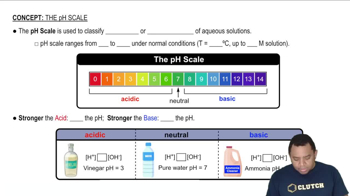
pH Scale

The pH scale measures the acidity or basicity of a solution, ranging from 0 to 14. A pH of 7 is considered neutral, indicating that the concentration of hydrogen ions (H+) is equal to that of hydroxide ions (OH-). Values below 7 represent acidic solutions, while values above 7 indicate basic solutions.
Recommended video:

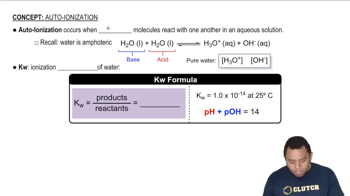
Water Ionization

Water (H2O) can dissociate into hydrogen ions (H+) and hydroxide ions (OH-) in a process called ionization. In pure water at 25°C, this dissociation occurs to a very small extent, resulting in equal concentrations of H+ and OH-, which is approximately 1 x 10^-7 moles per liter, leading to a neutral pH of 7.
Recommended video:
Guided course
02:22
Auto-Ionization and Kw

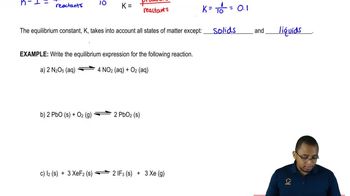
Equilibrium in Pure Water

In a neutral solution, the equilibrium between H+ and OH- ions is maintained, meaning that any addition of acids or bases will disrupt this balance. At a pH of 7, the concentrations of H+ and OH- are equal, demonstrating that pure water is neither acidic nor basic, thus maintaining its neutral status.
Recommended video:
Guided course
03:43
The Equilibrium Constant Example 1