Calculate the [H3O+] of each aqueous solution with the following [OH-]: a. baking soda, 1.0 × 10⁻⁶ M
Verified step by step guidance
1
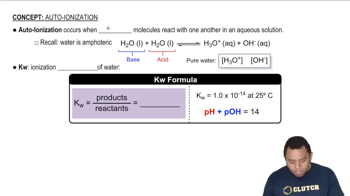
Step 1: Recall the relationship between [H₃O⁺] and [OH⁻] in aqueous solutions, which is given by the ion-product constant for water: . At 25°C, .
Step 2: Rearrange the equation to solve for [H₃O⁺]: .
Step 3: Substitute the given value of [OH⁻] into the equation. For baking soda, [OH⁻] = . The equation becomes: .
Step 4: Simplify the expression by dividing the values in the numerator and denominator. Use the rules of exponents: .
Step 5: Conclude that the [H₃O⁺] for the solution is . This indicates the solution is slightly basic, as [H₃O⁺] is less than .
Verified video answer for a similar problem:
This video solution was recommended by our tutors as helpful for the problem above
Video duration:
1m
Play a video:
Was this helpful?
Key Concepts
Here are the essential concepts you must grasp in order to answer the question correctly.
pH and pOH Relationship
The pH and pOH of a solution are related through the equation pH + pOH = 14 at 25°C. This relationship allows us to calculate one from the other. Since pH measures the concentration of hydrogen ions [H₃O⁺] and pOH measures the concentration of hydroxide ions [OH⁻], knowing one enables the determination of the other, which is essential for understanding acid-base chemistry.
The ion product of water (Kw) is a constant that equals 1.0 x 10⁻¹⁴ at 25°C, representing the product of the concentrations of hydrogen ions [H₃O⁺] and hydroxide ions [OH⁻]. This means that in any aqueous solution, the product of [H₃O⁺] and [OH⁻] will always equal Kw. This concept is crucial for calculating the concentration of [H₃O⁺] when [OH⁻] is known.
To find the concentration of hydronium ions [H₃O⁺] from a given concentration of hydroxide ions [OH⁻], you can use the formula [H₃O⁺] = Kw / [OH⁻]. By substituting the known value of [OH⁻] into this equation, you can determine the corresponding [H₃O⁺] concentration, which is essential for understanding the acidity of the solution.