Pearson+ LogoPearson+ Logo
Ch.11 Introduction to Organic Chemistry: Hydrocarbons
Timberlake - Chemistry: An Introduction to General, Organic, and Biological Chemistry 14th Edition
Timberlake14thChemistry: An Introduction to General, Organic, and Biological ChemistryISBN: 9781292472249Not the one you use?Change textbook
Chapter 11, Problem 42a

Match the following physical and chemical properties with octane, C8H18 found in gasoline, or magnesium sulfate, MgSO4 also called Epsom salts:
a. contains only covalent bonds

Verified step by step guidance
1
Step 1: Understand the nature of the bonds in the two compounds. Octane (C₈H₁₈) is a hydrocarbon, meaning it is composed entirely of carbon (C) and hydrogen (H) atoms. These atoms are connected by covalent bonds, which involve the sharing of electrons between atoms.
Step 2: Analyze magnesium sulfate (MgSO₄). This compound consists of magnesium (Mg), sulfur (S), and oxygen (O). Magnesium forms ionic bonds with the sulfate ion (SO₄²⁻), while within the sulfate ion, sulfur and oxygen are connected by covalent bonds.
Step 3: Compare the bonding in the two compounds. Octane contains only covalent bonds, as all the bonds between carbon and hydrogen atoms are covalent. In contrast, magnesium sulfate contains both ionic and covalent bonds.
Step 4: Match the property 'contains only covalent bonds' to the correct compound. Based on the analysis, this property applies to octane (C₈H₁₈).
Step 5: Conclude that magnesium sulfate (MgSO₄) does not match this property because it contains ionic bonds in addition to covalent bonds.

Verified video answer for a similar problem:

This video solution was recommended by our tutors as helpful for the problem above.
Was this helpful?

Key Concepts

Here are the essential concepts you must grasp in order to answer the question correctly.

Covalent Bonds

Covalent bonds are a type of chemical bond where two atoms share one or more pairs of electrons. This sharing allows each atom to attain the electron configuration of a noble gas, leading to greater stability. In organic compounds like octane (C₈H₁₈), covalent bonds are predominant, as they consist of carbon and hydrogen atoms bonded together.
Recommended video:
Guided course
01:04
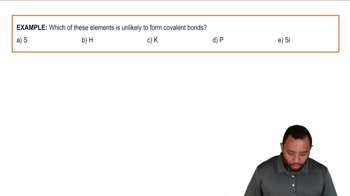
Covalent Bonds Example 1

Octane (C₈H₁₈)

Octane is a hydrocarbon and a key component of gasoline, consisting of eight carbon atoms and eighteen hydrogen atoms. It is a non-polar molecule that primarily exhibits covalent bonding. Understanding octane's structure is essential for recognizing its physical and chemical properties, such as its flammability and energy content.
Recommended video:
Guided course
1:36
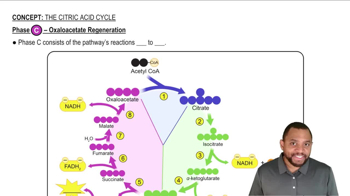
Phase C - Oxaloacetate Regeneration Concept 7

Magnesium Sulfate (MgSO₄)

Magnesium sulfate, commonly known as Epsom salts, is an ionic compound composed of magnesium ions (Mg²⁺) and sulfate ions (SO₄²⁻). Unlike octane, it contains ionic bonds, which result from the electrostatic attraction between positively and negatively charged ions. This distinction is crucial when comparing the bonding types and properties of different substances.
Recommended video:
Guided course
05:07
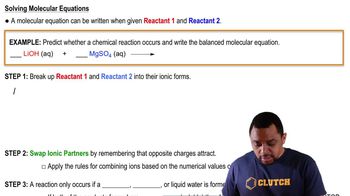
Molecular Equations Example 2