Pearson+ LogoPearson+ Logo
Ch.18 Metabolic Pathways and ATP Production
Timberlake - Chemistry: An Introduction to General, Organic, and Biological Chemistry 14th Edition
Timberlake14thChemistry: An Introduction to General, Organic, and Biological ChemistryISBN: 9781292472249Not the one you use?Change textbook
Chapter 18, Problem 82

What is the coenzyme used in glycolysis?

Verified step by step guidance
1
Understand that glycolysis is a metabolic pathway where glucose is broken down into pyruvate, producing ATP and NADH as energy carriers.
Recall that coenzymes are molecules that assist enzymes in catalyzing reactions. In glycolysis, a key coenzyme is involved in the transfer of electrons during oxidation-reduction reactions.
Identify that the coenzyme used in glycolysis is nicotinamide adenine dinucleotide (NAD⁺), which acts as an electron carrier.
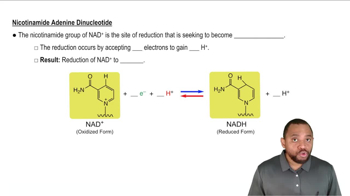
During glycolysis, NAD⁺ is reduced to NADH when it accepts electrons and a hydrogen ion (H⁺) in the reaction catalyzed by glyceraldehyde-3-phosphate dehydrogenase.
Recognize the importance of NAD⁺ in glycolysis, as it ensures the continuation of the pathway by regenerating NAD⁺ through subsequent processes like fermentation or oxidative phosphorylation.

Key Concepts

Here are the essential concepts you must grasp in order to answer the question correctly.

Glycolysis

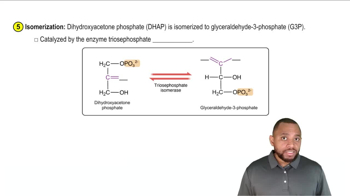
Glycolysis is a metabolic pathway that converts glucose into pyruvate, producing a small amount of ATP and NADH in the process. It occurs in the cytoplasm of cells and is the first step in cellular respiration. Understanding glycolysis is essential for identifying the coenzymes involved in this pathway.
Recommended video:
Guided course
1:26
Glycolysis Concept 5

Coenzymes

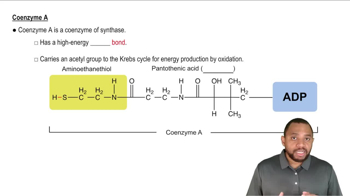
Coenzymes are organic molecules that assist enzymes in catalyzing reactions. They often act as carriers for chemical groups or electrons during metabolic processes. In glycolysis, coenzymes play a crucial role in facilitating the transfer of electrons and protons, which is vital for energy production.
Recommended video:
Guided course
1:02
Coenzyme A Concept 4

NAD+ (Nicotinamide adenine dinucleotide)

NAD+ is a key coenzyme in glycolysis that functions as an electron carrier. It accepts electrons during the oxidation of glucose, becoming reduced to NADH. This conversion is critical for the energy yield of glycolysis and for subsequent metabolic pathways, such as the citric acid cycle.
Recommended video:
Guided course
2:19
Nicotinamide Adenine Dinucleotide Concept 2