Pearson+ LogoPearson+ Logo
Ch.18 Metabolic Pathways and ATP Production
Timberlake - Chemistry: An Introduction to General, Organic, and Biological Chemistry 14th Edition
Timberlake14thChemistry: An Introduction to General, Organic, and Biological ChemistryISBN: 9781292472249Not the one you use?Change textbook
Chapter 18, Problem 98b

Which of the following molecules will produce the most ATP per mole?
b. glucose or two pyruvate

Verified step by step guidance
1
Step 1: Understand the context of ATP production. ATP (adenosine triphosphate) is the primary energy currency in cells, and its production is closely tied to cellular respiration processes such as glycolysis, the citric acid cycle, and oxidative phosphorylation.
Step 2: Recall the metabolic pathways involved. Glucose undergoes glycolysis, producing two pyruvate molecules, along with a net gain of 2 ATP and 2 NADH. Pyruvate can then enter the mitochondria for further processing in the citric acid cycle and oxidative phosphorylation.
Step 3: Compare the ATP yield from glucose versus two pyruvate molecules. Glucose is the starting molecule for glycolysis, which produces two pyruvate molecules. The ATP yield from glucose includes the ATP generated during glycolysis, the citric acid cycle, and oxidative phosphorylation. Two pyruvate molecules bypass glycolysis and directly enter the citric acid cycle, contributing ATP only from the citric acid cycle and oxidative phosphorylation.
Step 4: Consider the additional energy contributions. Glucose provides more ATP overall because it includes the ATP generated during glycolysis, whereas two pyruvate molecules do not contribute the ATP from glycolysis.
Step 5: Conclude the comparison. Glucose will produce more ATP per mole compared to two pyruvate molecules because it undergoes glycolysis in addition to the citric acid cycle and oxidative phosphorylation.

Key Concepts

Here are the essential concepts you must grasp in order to answer the question correctly.

Cellular Respiration

Cellular respiration is the metabolic process by which cells convert nutrients into energy, specifically ATP. It involves several stages, including glycolysis, the Krebs cycle, and oxidative phosphorylation. Understanding this process is crucial for determining how different molecules, like glucose and pyruvate, contribute to ATP production.
Recommended video:
Guided course
1:47
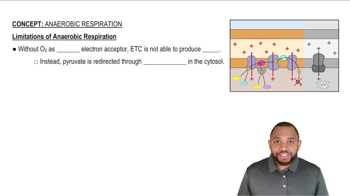
Anaerobic Respiration Concept 1

ATP Yield from Glucose vs. Pyruvate

Glucose, when fully oxidized through cellular respiration, can yield up to 30-32 ATP molecules per molecule, while pyruvate, which is produced from glucose during glycolysis, can yield significantly less ATP when further metabolized. This difference in ATP yield is essential for comparing the energy potential of these two molecules.
Recommended video:
Guided course
2:21
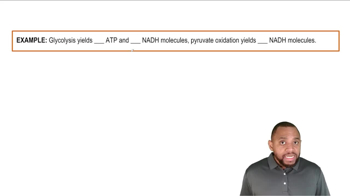
Total Energy From Glucose Example 1

Glycolysis and Fermentation

Glycolysis is the initial step in glucose metabolism, breaking down glucose into two pyruvate molecules and producing a net gain of 2 ATP. If oxygen is not available, pyruvate can undergo fermentation, which does not produce additional ATP. Understanding these pathways helps clarify why glucose is generally more efficient for ATP production than pyruvate alone.
Recommended video:
Guided course
1:26
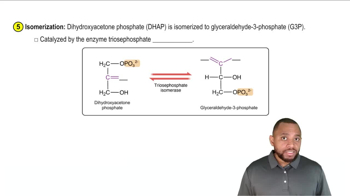
Glycolysis Concept 5