KF is a strong electrolyte, and HF is a weak electrolyte. How is the solution of KF different from that of HF?
Ch.9 Solutions
Timberlake14thChemistry: An Introduction to General, Organic, and Biological ChemistryISBN: 9781292472249Not the one you use?Change textbook
Chapter 9, Problem 11b
Indicate whether aqueous solutions of each of the following solutes contain only ions, only molecules, or mostly molecules and a few ions: c. fructose, C6H12O6, a nonelectrolyte
Verified step by step guidance1
Identify the type of compound: Fructose (C₆H₁₂O₆) is a covalent compound, specifically a sugar, and is classified as a nonelectrolyte.
Understand the behavior of nonelectrolytes in water: Nonelectrolytes do not dissociate into ions when dissolved in water. Instead, they dissolve as intact molecules.
Determine the composition of the solution: Since fructose does not dissociate, the solution will contain only molecules of fructose and no ions.
Clarify the distinction: Unlike electrolytes (which can be strong or weak and produce ions in solution), nonelectrolytes like fructose remain as molecules in aqueous solutions.
Conclude: The aqueous solution of fructose (C₆H₁₂O₆) contains only molecules, with no ions present.

Verified video answer for a similar problem:
This video solution was recommended by our tutors as helpful for the problem above.
Video duration:
2mWas this helpful?
Key Concepts
Here are the essential concepts you must grasp in order to answer the question correctly.
Electrolytes vs. Nonelectrolytes
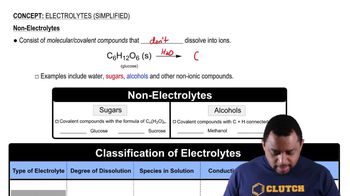
Electrolytes are substances that dissociate into ions when dissolved in water, allowing the solution to conduct electricity. In contrast, nonelectrolytes do not dissociate into ions and remain as intact molecules in solution. Understanding this distinction is crucial for determining the behavior of solutes in aqueous solutions.
Recommended video:
Guided course
Electrolytes (Simplified) Concept 3
Dissociation in Aqueous Solutions
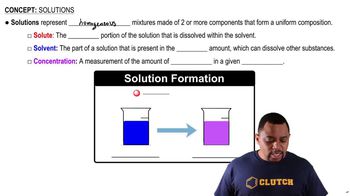
Dissociation refers to the process by which a compound separates into its constituent ions in a solvent, typically water. This process is essential for electrolytes, as it influences the conductivity and chemical reactivity of the solution. For nonelectrolytes like fructose, dissociation does not occur, and the solute remains as whole molecules.
Recommended video:
Guided course
Solutions
Properties of Fructose
Fructose, a simple sugar (C₆H₁₂O₆), is classified as a nonelectrolyte because it does not ionize in solution. When dissolved in water, fructose molecules interact with water but do not break apart into ions. This characteristic affects the solution's properties, such as its conductivity and osmotic behavior.
Recommended video:
Guided course
Chemical Properties Example 1
Related Practice
Textbook Question
3282
views
Textbook Question
Write a balanced equation for the dissociation of each of the following strong electrolytes in water:
d. Fe(NO3)3
2046
views
Textbook Question
Indicate whether aqueous solutions of each of the following solutes contain only ions, only molecules, or mostly molecules and a few ions:
a. acetic acid, HC2H3O2, a weak electrolyte
1556
views
Textbook Question
Indicate whether aqueous solutions of each of the following solutes contain only ions, only molecules, or mostly molecules and a few ions:
b. NaBr, a strong electrolyte
2020
views
Textbook Question
Classify the solute represented in each of the following equations as a strong, weak, or nonelectrolyte:
a.
1824
views
Textbook Question
Classify the solute represented in each of the following equations as a strong, weak, or nonelectrolyte:
b. NH3(g) + H2O(l) ⇌ NH4+(aq) + OH–(aq)
1834
views